Surfing around yesterday I came across this clip from South Park. Now, I'm not a big South Park fan (Yeah, I know, surprise surprise, but I'm not), but it got me thinking (and you know where that leads).
And you what? I think they're on to something with this.
Think about it. Whenever a guy gets into trouble doing something stupid, it's usually because he was trying to impress a girl. Oh, come on fellas, we can admit it. We're like peacocks, just another big stupid bird scratching in the dirt - until the peahens show up. Then all of a sudden we're spreading our gaudy tails and and making loud obnoxious noises in a bid for attention. This isn't any secret, it's hardwired into us. More trips to the emergency room can be attributed to this one male quirk than all other manly endeavors combined. It's not our fault, we just can't help ourselves.
And I got to thinking, you know, the United States is a lot like a guy. A big, blustering, swaggering, beer swilling, tractor pulling guy. And Canada? Canada is a lot like a pretty girl. A country girl free and full of promise, with a come hither coquettishness and socialized medicine that just begs us to impress her. And so we continually embark on feats of strength and daring-do, hoping she'll go to the prom with us. Instead, we end up in the emergency room.
See? The logic is inescapable. It is all Canada's fault.
Maybe I need to watch more South Park.
Monday, March 31, 2008


Friday, March 28, 2008
UCF Bomb Shelter
In the comments of the previous post, commenter Jeri suggested the following: ...maybe we need a UCF bomb shelter, stocked with good beer, gourmet food and a lifetime supply of used SF books & DVDs.
I find this idea interesting and worth pursuing.
So, here's the thing - if we, the UCF (I forget what that actually stands for - but we all know who we are) and those we choose to let in, were to build ourselves a lifeboat as an insurance policy against the growing insanity - and against the hordes of YEC spewing, fuzzy logicked, neocon, Britney loving, Paris worshiping, Limbaugh listening, Pluto-haytin', restroom cruising, crazed hollow-eyed zombie mobs who think that No Country For Old Men was actually a deeply meaningful movie and who will soon be roaming the surface of our ravaged world in search of gullible and tasty voter flesh - what then would that look like?
Assumptions and ground rules:
1) Since we all make millions in disposable income from our secret lives as kings and queens and various nobility of the blogohedron - we'll assume unlimited funding.
2) The shelter will accommodate the principle members of the UCF and their families, loved ones, pet budgies, and so on and so forth within reason (reason being whatever we define it to be based on arcane rules that none of us actually understand but assume that everybody else does). All others are subject to rigorous screening, a trial period, and random chance.
3) BYOB and enough to share.
4) Government will based on something vaguely Heinleinesque. However, decisions affecting the group will require a special two-part parliamentary procedure as follows: First: we all drink, dance, and generally whoop it up. Once we're all good and lubricated we'll discuss the issue and vote. Second: If the decision still sounds like a good idea the next morning when we're sober and hungover - we'll go with it. Otherwise, shake, lubricate, and repeat as necessary.
5) Assume plenty of room, automated child and pet care, a big damn kitchen, a top of the line video/audio entertainment system with media on demand, Broadband, and fresh hot chocolate chip cookies.
OK, that's enough with the ground rules, we'll just wing the rest.
So here's what we need to get the ball rolling:
1) Location. Where and why? Don't limit yourself to Earth, however, I think anything beyond the Kuiper Belt is probably mostly wishful thinking.
2) Food and Drink: Somebody is going to have to make a supply run prior to locking the door, we'd better have a list. Just saying. Calling for Take-Out is probably not going to work, and I don't want this to turn out like that time my unit deployed and the Supply Officer forgot to bring along coffee (yes, this actually happened to me. Bad Suppo. Bad. No biscuit).
3) Music: Because, seriously, I've been trapped in windowless secret buildings for extended periods with nothing but government issue Musak versions of various 70's soft rock bands looping endlessly on the cover sound system - and frankly I'd probably end up killing all of you and decorating myself with your entrails if I have to do it again. Really.
4) Movies: Because when we're not drinking, dancing, and generally whooping it up in parliament, we're going to need something to watch (somebody put popcorn on the shopping list). Besides good movies, we're going to need some really crappy flicks so that we can do the heckle as a group bonding thing.
5) Books: Because if we don't save the books from the zombie hordes, well then, what's the point of surviving?
6) Various and sundry miscellanea: Whatever else you think we need.
I find this idea interesting and worth pursuing.
So, here's the thing - if we, the UCF (I forget what that actually stands for - but we all know who we are) and those we choose to let in, were to build ourselves a lifeboat as an insurance policy against the growing insanity - and against the hordes of YEC spewing, fuzzy logicked, neocon, Britney loving, Paris worshiping, Limbaugh listening, Pluto-haytin', restroom cruising, crazed hollow-eyed zombie mobs who think that No Country For Old Men was actually a deeply meaningful movie and who will soon be roaming the surface of our ravaged world in search of gullible and tasty voter flesh - what then would that look like?
Assumptions and ground rules:
1) Since we all make millions in disposable income from our secret lives as kings and queens and various nobility of the blogohedron - we'll assume unlimited funding.
2) The shelter will accommodate the principle members of the UCF and their families, loved ones, pet budgies, and so on and so forth within reason (reason being whatever we define it to be based on arcane rules that none of us actually understand but assume that everybody else does). All others are subject to rigorous screening, a trial period, and random chance.
3) BYOB and enough to share.
4) Government will based on something vaguely Heinleinesque. However, decisions affecting the group will require a special two-part parliamentary procedure as follows: First: we all drink, dance, and generally whoop it up. Once we're all good and lubricated we'll discuss the issue and vote. Second: If the decision still sounds like a good idea the next morning when we're sober and hungover - we'll go with it. Otherwise, shake, lubricate, and repeat as necessary.
5) Assume plenty of room, automated child and pet care, a big damn kitchen, a top of the line video/audio entertainment system with media on demand, Broadband, and fresh hot chocolate chip cookies.
OK, that's enough with the ground rules, we'll just wing the rest.
So here's what we need to get the ball rolling:
1) Location. Where and why? Don't limit yourself to Earth, however, I think anything beyond the Kuiper Belt is probably mostly wishful thinking.
2) Food and Drink: Somebody is going to have to make a supply run prior to locking the door, we'd better have a list. Just saying. Calling for Take-Out is probably not going to work, and I don't want this to turn out like that time my unit deployed and the Supply Officer forgot to bring along coffee (yes, this actually happened to me. Bad Suppo. Bad. No biscuit).
3) Music: Because, seriously, I've been trapped in windowless secret buildings for extended periods with nothing but government issue Musak versions of various 70's soft rock bands looping endlessly on the cover sound system - and frankly I'd probably end up killing all of you and decorating myself with your entrails if I have to do it again. Really.
4) Movies: Because when we're not drinking, dancing, and generally whooping it up in parliament, we're going to need something to watch (somebody put popcorn on the shopping list). Besides good movies, we're going to need some really crappy flicks so that we can do the heckle as a group bonding thing.
5) Books: Because if we don't save the books from the zombie hordes, well then, what's the point of surviving?
6) Various and sundry miscellanea: Whatever else you think we need.
I know crazy when I see it
From the MedlinePlus Medical Encyclopedia: Psychosis: a severe mental condition characterized by a loss of contact with reality.
The symptoms of psychosis include:
- Loss of touch with reality
- Seeing, hearing, feeling, or otherwise perceiving things that are not there
- Disorganized thought and/or speech
- Emotion is exhibited in an abnormal manner
- Extreme excitement
- Confusion
- Depression and sometimes suicidal thoughts
- Unfounded fear/suspicion
- Mistaken perceptions
- False beliefs
Basically what we're talking about here is a mental illness that can prevent a person from functioning normally. If the condition is left untreated, there is a significant possibility of self-harm or harm to others. People experiencing psychosis may report hallucinations or delusional beliefs, and may exhibit personality changes and disorganized thinking. This may be accompanied by unusual or bizarre behavior, as well as difficulty with social interaction.
Now obviously, I'm no doctor, but if Sanjay Gupta can pretend to be a doctor on CNN, I feel pretty comfortable pretending to be a psychologist on the internet and I'm saying that psychosis is a complex and severe mental disorder. The clinical definition, identification, and classification is best left to actual professionals, but it doesn't take Sigmund Freud and his cigar to figure out that if a person is manifestly, obviously, blatantly and repeatedly meeting ten out of ten defining diagnostic criteria for the batshit gibbering but-I-am-Napoleon fuzzy wuzzies, then you should be getting that person some serious help of the rubber room and Thorazine variety.
_____________________________
March 27, 2008:
The patient and his perception of reality: US President George Bush hails Iraqi leader for "Remarkable" progress. This isn't me making snarky comments, this is the situation as the patient sees it, in his own words. Watch the video, tell me I'm the crazy one here.
Google results for Iraq for the last week. This search-results set includes both Liberal and Conservative biased reports, from US, Coalition Nation, Uninvolved Nation, and Hostile Nation sources. Taken together they give a testable and accurate picture of reality on the ground. And, they all agree on one thing when it comes to the situation in Iraq - see if you can figure out what it is.
Let's do the math, shall we?
- Loss of touch with reality? [Check]
- Seeing, hearing, feeling, or otherwise perceiving things that are not there? [Check]
- Disorganized thought and/or speech? [Check and Check]
- Emotion is exhibited in an abnormal manner? [Big Check]
- Extreme excitement? [Varies - half Check]
- Confusion? [Check, Check, and Check]
- Depression and sometimes suicidal thoughts? [Check and
- Unfounded fear/suspicion [Check and Check]
- Mistaken perceptions (illusions) [Check]
- False Beliefs (delusions) [Check]
________________
Total: 95% positive is we're being generous, 100% if we're not.
Additional indicators:
Engaged in behavior harmful to others? [Big fucking Checkaroo]
Unable to function normally in society? [Check]
Bizarre Behavior in social situations? [Check]
Yeah, I'm the crazy one. Hand me the butterfly net, will you?
Thursday, March 27, 2008
What I learned yesterday
I learned three things yesterday.
1) Migraines suck.
OK, I didn't actually learn this yesterday, I've known it for some time. Yesterday just reinforced the knowledge.
I've had migraines all of my life. As I've gotten older, they've gotten less severe. Usually I just get head splitting pain in the front part of my skull and what feels like intense pressure right behind my left eye. Before it comes on I get depressed and moody. Afterward I feel like the inside of my head is bruised for a couple of days. Sometimes, I feel a little queasy. It doesn't happen all that often, maybe once every other month, and I can usually work through it.
Every once in a while it's worse. Much worse.
Yesterday was one of those days. I got the whole sheebang: pain, pressure, light sensitivity, and intense nausea. It was extremely unpleasant. Extremely. It lasted the whole damned day, getting worse in the evening. By the time I went to bed last night I was so unbelievably ill that I was considering going out to the shop and putting my head in the drill press in order to let some of the pressure out. Fortunately it didn't come to that.
This morning, I'm still a little queasy, but it's mostly over. The inside of my head feels the floor of a New York taxi cab - but other than that I'm much better. If the process holds true to form, by this afternoon I'll be manic with energy. Let's hope so, eh?
2) Despite the headache, I can still find humor in things.
I had to go into Anchorage yesterday, no choice. I had to pick up some items from one of the customers I do custom woodwork for. I went early, before the velociraptor in my head decided that it was going to bite its way out through my eyes. On the highway, I got behind a brand new, shiny red monster Ford pickup. I knew that the proud owner - the big guy in the driver's seat wearing the enormous cowboy hat and expensive Oakely sunglasses (you know, the sort of regalia that just screams asshole) - had just bought the vehicle because he had a temporary license plate in the back window and I could see tape from the recently removed dealer sticker on the left rear passenger window as he blew past me.
On the shiny chrome rear fender was this bumper sticker:

Hmmm, says I to myself - this guy has got issues. Seriously, brand new $40K truck and the first thing he does is slap on a "I heart crack whores" bumper sticker? What a complete asshole.
Then I remembered an internet add I'd seen somewhere. For this site.
And suddenly, despite the pain in my head, things seemed a whole lot funnier - because, really, he was just so damned proud of himself and that new truck, and I suspect he had absolutely no idea what was on his bumper.
3) Small furry creatures + Electricity = Crispy Darkness.
After I got home the headache started to get worse - and the nausea set in. Sitting on the couch didn't help, and I couldn't focus on the screen long enough to read, so I thought maybe some fresh air would help (sometimes just walking around helps). I went outside. Bright sunlight stabbed me straight in the eyes (yeah, what the hell was I thinking?) and the velocirapther reflexively kicked me in the cerebral cortex. Augh! So, I staggered over to the shop like a sickly vampire seeking the comfort of the tomb. I had no sooner stepped inside, firmly shut the door, and had gotten as far from it as it is possible to get in my very large shop - when from somewhere down in the valley came a ringing BLAM! and all of the lights went out.
Despite my diminished mental capacity, I was able to immediately figure out that a very loud bang followed by abrupt darkness couldn't possibly be a good thing. I wondered if the thrashing velociraptor in my head had severed the optic nerves with it's claws. Oh, good, I thought, I'm blind. Nice. A moment before I had been wishing for less light, and viola wish granted. The shop is extremely well insulated and sealed, with the doors shut it was exactly like the inside of Dick Cheney's heart (Shutup, I figured out for myself that I really need to go purchase some battery powered emergency lighting, I'll get on it, thanks). I felt my way through the pitch dark, banging into various heavy cast iron stationary equipment with lots of pointy and protruding edges, carefully protecting my head with my hands.
My neighbors, Boyd and Deb, were out in their yard and yelled over to ask if I'd heard an explosion. Ahh, good, thought I to myself - the bang I heard wasn't actually a blood vessel letting go inside my skull. And I can see. Things are looking up.
I went inside the house and unplugged all of the computers and the entertainment center. I spent a minute trying to remember how to find the electric company's number without an internet connection - yes, I actually considered calling my wife at work and having her look it up on her computer. Then I thought, oh yeah, phonebook, doh!
The guy who answered the help line laughed.
See the squirrels are thawing out, dehibernating, defrosting, reanimating, resurrecting - whatever you call it, the fuzzy little bastards are out in force and seem to have a particular affinity for electrical transformers. The electric company has had over twenty power failures in the last two days, all directly attributed to toasted rodent. Apparently one decided to commit suicide in the transformer that supplies my house. The help line guy said he'd send somebody right out.
I don't actually know how long it took to fix. I curled up in a ball on the sunroom sofa and went to sleep for a couple of hours. When I woke up sometime much later, the power was on.
Stupid tree rats.
1) Migraines suck.
OK, I didn't actually learn this yesterday, I've known it for some time. Yesterday just reinforced the knowledge.
I've had migraines all of my life. As I've gotten older, they've gotten less severe. Usually I just get head splitting pain in the front part of my skull and what feels like intense pressure right behind my left eye. Before it comes on I get depressed and moody. Afterward I feel like the inside of my head is bruised for a couple of days. Sometimes, I feel a little queasy. It doesn't happen all that often, maybe once every other month, and I can usually work through it.
Every once in a while it's worse. Much worse.
Yesterday was one of those days. I got the whole sheebang: pain, pressure, light sensitivity, and intense nausea. It was extremely unpleasant. Extremely. It lasted the whole damned day, getting worse in the evening. By the time I went to bed last night I was so unbelievably ill that I was considering going out to the shop and putting my head in the drill press in order to let some of the pressure out. Fortunately it didn't come to that.
This morning, I'm still a little queasy, but it's mostly over. The inside of my head feels the floor of a New York taxi cab - but other than that I'm much better. If the process holds true to form, by this afternoon I'll be manic with energy. Let's hope so, eh?
2) Despite the headache, I can still find humor in things.
I had to go into Anchorage yesterday, no choice. I had to pick up some items from one of the customers I do custom woodwork for. I went early, before the velociraptor in my head decided that it was going to bite its way out through my eyes. On the highway, I got behind a brand new, shiny red monster Ford pickup. I knew that the proud owner - the big guy in the driver's seat wearing the enormous cowboy hat and expensive Oakely sunglasses (you know, the sort of regalia that just screams asshole) - had just bought the vehicle because he had a temporary license plate in the back window and I could see tape from the recently removed dealer sticker on the left rear passenger window as he blew past me.
On the shiny chrome rear fender was this bumper sticker:

Hmmm, says I to myself - this guy has got issues. Seriously, brand new $40K truck and the first thing he does is slap on a "I heart crack whores" bumper sticker? What a complete asshole.
Then I remembered an internet add I'd seen somewhere. For this site.
And suddenly, despite the pain in my head, things seemed a whole lot funnier - because, really, he was just so damned proud of himself and that new truck, and I suspect he had absolutely no idea what was on his bumper.
3) Small furry creatures + Electricity = Crispy Darkness.
After I got home the headache started to get worse - and the nausea set in. Sitting on the couch didn't help, and I couldn't focus on the screen long enough to read, so I thought maybe some fresh air would help (sometimes just walking around helps). I went outside. Bright sunlight stabbed me straight in the eyes (yeah, what the hell was I thinking?) and the velocirapther reflexively kicked me in the cerebral cortex. Augh! So, I staggered over to the shop like a sickly vampire seeking the comfort of the tomb. I had no sooner stepped inside, firmly shut the door, and had gotten as far from it as it is possible to get in my very large shop - when from somewhere down in the valley came a ringing BLAM! and all of the lights went out.
Despite my diminished mental capacity, I was able to immediately figure out that a very loud bang followed by abrupt darkness couldn't possibly be a good thing. I wondered if the thrashing velociraptor in my head had severed the optic nerves with it's claws. Oh, good, I thought, I'm blind. Nice. A moment before I had been wishing for less light, and viola wish granted. The shop is extremely well insulated and sealed, with the doors shut it was exactly like the inside of Dick Cheney's heart (Shutup, I figured out for myself that I really need to go purchase some battery powered emergency lighting, I'll get on it, thanks). I felt my way through the pitch dark, banging into various heavy cast iron stationary equipment with lots of pointy and protruding edges, carefully protecting my head with my hands.
My neighbors, Boyd and Deb, were out in their yard and yelled over to ask if I'd heard an explosion. Ahh, good, thought I to myself - the bang I heard wasn't actually a blood vessel letting go inside my skull. And I can see. Things are looking up.
I went inside the house and unplugged all of the computers and the entertainment center. I spent a minute trying to remember how to find the electric company's number without an internet connection - yes, I actually considered calling my wife at work and having her look it up on her computer. Then I thought, oh yeah, phonebook, doh!
The guy who answered the help line laughed.
See the squirrels are thawing out, dehibernating, defrosting, reanimating, resurrecting - whatever you call it, the fuzzy little bastards are out in force and seem to have a particular affinity for electrical transformers. The electric company has had over twenty power failures in the last two days, all directly attributed to toasted rodent. Apparently one decided to commit suicide in the transformer that supplies my house. The help line guy said he'd send somebody right out.
I don't actually know how long it took to fix. I curled up in a ball on the sunroom sofa and went to sleep for a couple of hours. When I woke up sometime much later, the power was on.
Stupid tree rats.
Tuesday, March 25, 2008
Persona Non Grata (because he's a dumbass) Updated
Please, disregard the below whiny stupidity.
I was just going to delete this post, but decided not to for various reasons.
I should have known better - However, when I have a migraine coming on I don't think clearly (something about having a spike driven into the space between my eyes)
Scalzi has a post up; it is exactly what you people said it was and not personal.
So again, apologies for acting like a boob.
Now, if you don't mind, I'm going to lay on the couch with an icepack over my eyes until the kid gets home from school.
---------------------------------------
Hmmmm, I guess I must have pissed Scalzi off.
My comments no longer appear on the Whatever. Period.
Yesterday I posted a comment and it went into moderation, and eventually showed up hours later. Why I can't fathom, it was an offhand semi-humorous (I thought) comment on the Kodi laser beam post.
Today, I'm history. I posted two comments and zip, goodbye. Comments posted after mine appeared, so I guess he reviewed the queue and found me being an asstard. Can't think of anything I did offhand. Maybe he didn't care for the comments I made here about the 'e', though they weren't directed at him but rather the trolls who've taken up residence there.
Whatever, I guess. Sigh.
I was just going to delete this post, but decided not to for various reasons.
I should have known better - However, when I have a migraine coming on I don't think clearly (something about having a spike driven into the space between my eyes)
Scalzi has a post up; it is exactly what you people said it was and not personal.
So again, apologies for acting like a boob.
Now, if you don't mind, I'm going to lay on the couch with an icepack over my eyes until the kid gets home from school.
---------------------------------------
Hmmmm, I guess I must have pissed Scalzi off.
My comments no longer appear on the Whatever. Period.
Yesterday I posted a comment and it went into moderation, and eventually showed up hours later. Why I can't fathom, it was an offhand semi-humorous (I thought) comment on the Kodi laser beam post.
Today, I'm history. I posted two comments and zip, goodbye. Comments posted after mine appeared, so I guess he reviewed the queue and found me being an asstard. Can't think of anything I did offhand. Maybe he didn't care for the comments I made here about the 'e', though they weren't directed at him but rather the trolls who've taken up residence there.
Whatever, I guess. Sigh.
Senator cures cancer, invents Internet, and discovers fabled Iraqi WMDs!
Oh yes, yes she did go there.
According to reliable media source, Sinbad the Comedian, Hillary Clinton may have, uh, embellished her combat experience in Bosnia.
So?
I mean, seriously, so?
Look bullshitting your way into the White House is a time honored tradition in the United States. Her husband did it. So did the current jackass. And fudging the truth is, on the face of things, a required skill in a President. I mean, seriously here, what if Lyndon Johnson couldn't have lied flat out with a straight face about the Gulf of Tonkin? Why, we might never have gotten into Vietnam! Think of all the great movies that would never have gotten made! The books that never would have been written. We'd have lost three decade's worth of entertainment. The whole world changing hippy peace movement wouldn't have happened, my God, the music - we'd have lost the music! What, I say what, would we compare every military action to nowadays? Pundits and newspaper editors would have nothing to work with; Iraq, Another Day At Disneyworld just doesn't have the same ring as Iraq, The New Vietnam?
And Nixon, what if Nixon told the truth about Watergate? Forest Gump would have been a lesser movie for it. Woodward and Bernstein would still be nothing but bullpen stringers if it wasn't for Nixon, and All the President's Men friggin' made Dustin Hoffman and Robert Redford's respective careers. Thank God for Nixon's ability to bullshit.
Hell, even Vice Presidents need the ability to bullshit. Al Gore invented the internet and discovered an inconvenient truth - he got the Nobel Prize and an Oscar!
Look at Jimmy Carter, remember him? No? He told the truth. Nothing, barely a footnote in history. How about Gerry Ford. Loser.
Reagan was the consummate bullshit artist. He was so good at it in fact, that he's a role model for the GOP! And Bill Clinton, need I go there? Hillary learned from the best. And then there's George the Lesser Decider, the King of the Malleable Past. Tell us about Vietnam, George. "Oh hell, yes, there was this one time I was knee deep in a bucket of hotwings outside a Louisiana National Guard Post, I took some fire the next morning in the shitter, I can tell you!"
Seriously, what's a presidential candidate anyway? A candidate isn't a person, a presidential candidate is entertainment. A president is a dozen speech writers, a make up guy, a voice coach, a public relations firm, and a dozen talk show hosts. So Hillary bullshitted about her past? Good! She's got the mad skillz I want in a President. And I say fuck it, if you're going to do it, go big. The bigger the better. Americans like to be entertained, give us a story, Hill, make it a good one.
 First Lady Hillary Clinton visits Philippines, draws fire.
I'd like to be charitable. I'd like to say I've been in similar situations and I know how information can get confused. I'd like to say that Hillary Clinton was telling what she thought was the truth, that she was repeating what her security detail told her. But, if you watch her and her daughter walk from the plane (the video is widely available, I'm not going to repost it here), you can easily see that there is no threat - and she is clearly aware that there is no threat, at all. Because, really, do you think that even cast iron Hillary Clinton would walk across open tarmac with her daughter in tow if there was even the slightest chance of sniper fire?
As I said over on Refugees from the City, I think that smell is the smell of desperation. Sad and inevitable.
According to reliable media source, Sinbad the Comedian, Hillary Clinton may have, uh, embellished her combat experience in Bosnia.
So?
I mean, seriously, so?
Look bullshitting your way into the White House is a time honored tradition in the United States. Her husband did it. So did the current jackass. And fudging the truth is, on the face of things, a required skill in a President. I mean, seriously here, what if Lyndon Johnson couldn't have lied flat out with a straight face about the Gulf of Tonkin? Why, we might never have gotten into Vietnam! Think of all the great movies that would never have gotten made! The books that never would have been written. We'd have lost three decade's worth of entertainment. The whole world changing hippy peace movement wouldn't have happened, my God, the music - we'd have lost the music! What, I say what, would we compare every military action to nowadays? Pundits and newspaper editors would have nothing to work with; Iraq, Another Day At Disneyworld just doesn't have the same ring as Iraq, The New Vietnam?
And Nixon, what if Nixon told the truth about Watergate? Forest Gump would have been a lesser movie for it. Woodward and Bernstein would still be nothing but bullpen stringers if it wasn't for Nixon, and All the President's Men friggin' made Dustin Hoffman and Robert Redford's respective careers. Thank God for Nixon's ability to bullshit.
Hell, even Vice Presidents need the ability to bullshit. Al Gore invented the internet and discovered an inconvenient truth - he got the Nobel Prize and an Oscar!
Look at Jimmy Carter, remember him? No? He told the truth. Nothing, barely a footnote in history. How about Gerry Ford. Loser.
Reagan was the consummate bullshit artist. He was so good at it in fact, that he's a role model for the GOP! And Bill Clinton, need I go there? Hillary learned from the best. And then there's George the Lesser Decider, the King of the Malleable Past. Tell us about Vietnam, George. "Oh hell, yes, there was this one time I was knee deep in a bucket of hotwings outside a Louisiana National Guard Post, I took some fire the next morning in the shitter, I can tell you!"
Seriously, what's a presidential candidate anyway? A candidate isn't a person, a presidential candidate is entertainment. A president is a dozen speech writers, a make up guy, a voice coach, a public relations firm, and a dozen talk show hosts. So Hillary bullshitted about her past? Good! She's got the mad skillz I want in a President. And I say fuck it, if you're going to do it, go big. The bigger the better. Americans like to be entertained, give us a story, Hill, make it a good one.
 First Lady Hillary Clinton visits Philippines, draws fire.
 I'd like to be charitable. I'd like to say I've been in similar situations and I know how information can get confused. I'd like to say that Hillary Clinton was telling what she thought was the truth, that she was repeating what her security detail told her. But, if you watch her and her daughter walk from the plane (the video is widely available, I'm not going to repost it here), you can easily see that there is no threat - and she is clearly aware that there is no threat, at all. Because, really, do you think that even cast iron Hillary Clinton would walk across open tarmac with her daughter in tow if there was even the slightest chance of sniper fire?
As I said over on Refugees from the City, I think that smell is the smell of desperation. Sad and inevitable.
The Rushes
As you may have inferred from certain hints I've dropped around here, I have a thing for British music. Especially small pub bands. I don't know why, I just do. And I really like this song.
One of the really cool things about the internet is the ability to access information on a truly global scale. Now if I could just buy the album, alas it is only available on iTunes Europe and on disk in London. Dammit.
But The Rushes are starting to get some serious play, hopefully their stuff will become available here in the States sooner rather than later.
One of the really cool things about the internet is the ability to access information on a truly global scale. Now if I could just buy the album, alas it is only available on iTunes Europe and on disk in London. Dammit.
But The Rushes are starting to get some serious play, hopefully their stuff will become available here in the States sooner rather than later.
Monday, March 24, 2008
Yet more lathe turned Alaskan Birch bowls
Just so you all don't think I've been wasting my time around here.
First, I wrote over 3500 good solid words today (which makes up for the 2000 I cut yesterday, this chapter is killing me!).
Then this afternoon I finished a couple of lathe projects.
These are my latest completed bowls. Some are available, some have been sold. And no, Shawn Powers' bowl is NOT among these pictures. His is in progress and will be finished this week, but it was turned from very wet wood and it's taking a while to dry. Sorry it's taking so long, Shawn, but you wanted something in particular and I selected a piece of wood with a lot of character. However, the next bowl picture I post will be yours. It will.
 Status: Sold
Full image gallery for this piece here.
Description: Alaska Birch heartwood, turned from fire damaged, dried wood harvested between Big Lake and Miller's Reach. The tree survived the famous (or infamous) Big Lake, Alaska fire, but had split from the heat. The crack contained charing, which the tree attempted to grow around. After turning, I sculpted the sides to emphasize the grain and the fire damage, then added filigree in flowing patterns. The piece is finished in Danish and walnut oil, and clear glossy acrylic. This piece was made on consignment for a family who lost their home in the fire.
Diameter 12", height 5"
 Status: Available.
Full image gallery for this piece here.
Description: Green turned Alaska Birch heartwood, natural edged. This bowl was turned from wood harvested in South Central Alaska. I left a thick inner bark lip around the rim. After turning, I sculpted the sides to emphasize the heartwood grain, then added filigree in flowing patterns. The piece is finished in light walnut oil, and clear glossy acrylic.
Diameter 7", height 7"
Price: $80USD

Status: Available.
Full image gallery for this piece here.
Description: Alaskan birch, shallow hollowform design. This piece was turned from wood harvested in South Central Alaska, laid up and dried for two years. It is made from a spalted birch burl, the grain is dense and complex with dark spalt lines in a 'eagle wing' pattern. The rim and sides have tightly grained, opalescent section that appear to glow under strong white light. Because of the dryness of the wood and the complex grain, this piece was extremely difficult to turn and required over a 100 hours to complete. The wood in incredibly beautiful and rare. Finished in simple tung oil and spar vanish.
Diameter 9", height 6"
Price: $170 USD

Status: Sold
Full image gallery for this piece here.
Description: Alaskan birch, lidded bowl with Celtic love knot finale. This piece was turned from cured Alaskan Birch harvested in South Central Alaska. I made this on request from Becca, who was looking for a jewelry box to set on a bedside nightstand. The sides and lid are lightly sculpted to emphasize the grain. Finished in tung oil and hard acrylic to resist scratching. Both the bowl and the lid are coated in a hard, shiny wax to prevent sticking.
Diameter 7", height 7"
Price $75USD
 Status: Sold
Full image gallery for this piece here.
Description: Alaskan birch heartwood, hollowform design. This piece was turned from wood harvested in South Central Alaska. The sides are burnished smooth and finished in simple tung oil and spar vanish.
Diameter 7", height 7"
Price: $75 USD
First, I wrote over 3500 good solid words today (which makes up for the 2000 I cut yesterday, this chapter is killing me!).
Then this afternoon I finished a couple of lathe projects.
These are my latest completed bowls. Some are available, some have been sold. And no, Shawn Powers' bowl is NOT among these pictures. His is in progress and will be finished this week, but it was turned from very wet wood and it's taking a while to dry. Sorry it's taking so long, Shawn, but you wanted something in particular and I selected a piece of wood with a lot of character. However, the next bowl picture I post will be yours. It will.
_____________________________
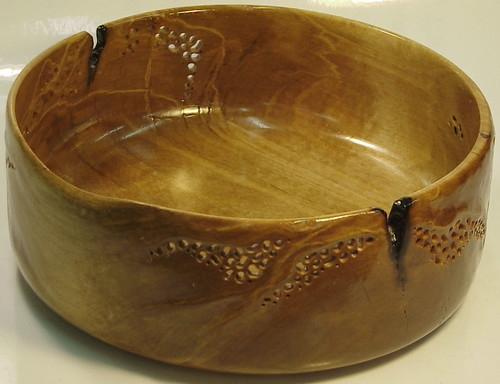
Alaskan Birch Bowl #54
 Status: Sold
Full image gallery for this piece here.
Description: Alaska Birch heartwood, turned from fire damaged, dried wood harvested between Big Lake and Miller's Reach. The tree survived the famous (or infamous) Big Lake, Alaska fire, but had split from the heat. The crack contained charing, which the tree attempted to grow around. After turning, I sculpted the sides to emphasize the grain and the fire damage, then added filigree in flowing patterns. The piece is finished in Danish and walnut oil, and clear glossy acrylic. This piece was made on consignment for a family who lost their home in the fire.
Diameter 12", height 5"
_____________________________
Alaskan Birch Bowl #55
 Status: Available.
Full image gallery for this piece here.
Description: Green turned Alaska Birch heartwood, natural edged. This bowl was turned from wood harvested in South Central Alaska. I left a thick inner bark lip around the rim. After turning, I sculpted the sides to emphasize the heartwood grain, then added filigree in flowing patterns. The piece is finished in light walnut oil, and clear glossy acrylic.
Diameter 7", height 7"
Price: $80USD
_____________________________
Alaskan Birch Bowl #58

Status: Available.
Full image gallery for this piece here.
Description: Alaskan birch, shallow hollowform design. This piece was turned from wood harvested in South Central Alaska, laid up and dried for two years. It is made from a spalted birch burl, the grain is dense and complex with dark spalt lines in a 'eagle wing' pattern. The rim and sides have tightly grained, opalescent section that appear to glow under strong white light. Because of the dryness of the wood and the complex grain, this piece was extremely difficult to turn and required over a 100 hours to complete. The wood in incredibly beautiful and rare. Finished in simple tung oil and spar vanish.
Diameter 9", height 6"
Price: $170 USD
_____________________________
Alaskan Birch Turned Jewelry Box#57

Status: Sold
Full image gallery for this piece here.
Description: Alaskan birch, lidded bowl with Celtic love knot finale. This piece was turned from cured Alaskan Birch harvested in South Central Alaska. I made this on request from Becca, who was looking for a jewelry box to set on a bedside nightstand. The sides and lid are lightly sculpted to emphasize the grain. Finished in tung oil and hard acrylic to resist scratching. Both the bowl and the lid are coated in a hard, shiny wax to prevent sticking.
Diameter 7", height 7"
Price $75USD
_____________________________
Alaskan Birch bowl #59
 Status: Sold
Full image gallery for this piece here.
Description: Alaskan birch heartwood, hollowform design. This piece was turned from wood harvested in South Central Alaska. The sides are burnished smooth and finished in simple tung oil and spar vanish.
Diameter 7", height 7"
Price: $75 USD
Pass the Ketchup
Yesterday a fire destroyed the Cargill beef processing plant in Booneville, Arkansas. This morning the fire is still smoldering.
The plant made upwards of 500,000 ground beef patties a day.
Can you imagine the smell? Mmmmmm, this morning the whole town smells like char grilled burgers.
Sorry for the folks who lost jobs and fortunately nobody was injured, but it just hit me as, uh, tasty.
The plant made upwards of 500,000 ground beef patties a day.
Can you imagine the smell? Mmmmmm, this morning the whole town smells like char grilled burgers.
Sorry for the folks who lost jobs and fortunately nobody was injured, but it just hit me as, uh, tasty.
Saturday, March 22, 2008
Willin' (Updated)
I spent the morning loading new music into my ZEN.
The discussion the other day on the Whatever regarding everybody's favorite Beatles tune got me pawing through my library, which led to uploading the complete Beatles portfolio onto the ZEN. Then, as long as I was at it I figured I'd add another couple of gigs of this and that.
Which somehow led to this:
Now I'm not any kind of huge Linda Ronstadt fan, but Willin' is a freakin' great tune. Poor Poor, Pitiful Me is pretty awesome too, but I like Warren Zevon's version better, same with Mohammed's Radio.
So, what else should I load on the ZEN? My library is pretty huge, you name it I probably got it.
--------------------------
I asked my son what he liked, and got this:
The discussion the other day on the Whatever regarding everybody's favorite Beatles tune got me pawing through my library, which led to uploading the complete Beatles portfolio onto the ZEN. Then, as long as I was at it I figured I'd add another couple of gigs of this and that.
Which somehow led to this:
Now I'm not any kind of huge Linda Ronstadt fan, but Willin' is a freakin' great tune. Poor Poor, Pitiful Me is pretty awesome too, but I like Warren Zevon's version better, same with Mohammed's Radio.
So, what else should I load on the ZEN? My library is pretty huge, you name it I probably got it.
--------------------------
I asked my son what he liked, and got this:
Gone all Day
Sorry folks, I was in Anchorage most of the day, and then I was installing new software - which seems to be working fine.
I'll be back online tomorrow, or maybe Sunday. Depending.
I'll be back online tomorrow, or maybe Sunday. Depending.
Thursday, March 20, 2008
Contagion
Beastly sent me an email this morning and it got me thinking about something.
How do you create a society that is manifestly mental ill?
Take the Nazis for example: Up until the 1930's Germany was a civilized and relatively stable culture. Oh, sure they had a military tradition and history of attempted conquest, but so did a lot of European countries in those days. Then Hitler and his band of raving psychopaths came along and in less than a decade they had infected the majority of the population with the stark staring crazies. Literally, Germany went insane. Like the movie, 28 Days Later, the insanity spread throughout the whole population. When people do what the Nazis did - that's clinical insanity, on a grand scale. And the Nazis weren't the only ones: Pol Pot and the Khmer Rouge, Lenin, Idi Amin, all the way back to the Inquisition. How does that happen? How does a whole society just go off the deep end?
Take the Jihadists for example: When you are willing to commit suicide by flying an airplane into a building, that's crazy. Sane people don't do things like that. When you see strapping twenty pounds of C4 to your chest as the only way to talk to your God and as a way to strike back at your perceived enemies, well, that's the clinical definition of batshit bonkers. Sane people don't commit mass murder, psychopaths commit mass murder. But the average person isn't a psychopath, so how do you turn the average person into a homicidal maniac with no sense of self preservation, and do it on commericial scale? How does this happen?
Take Timothy McVeigh for example: When a decorated combat veteran concludes that it is morally correct to murder 168 people in order to make a political statement - that's the classic definition of a psychopath. But, he managed to infect at least one other, Terry Nichols, and possibly more with his insanity. A rather large number of white supremacists and survivalists see him today as a hero, but they were already crazy. How does that happen?
And speaking of McVeigh, take the Branch Davidians and their standoff at Waco: I can understand David Koresh going insane, and he was manifestly bug-eating crazy, but how does a raving lunatic like that manage to convince hundreds of others that he is Jesus Christ reborn. When you believe that kind of thing, when you believe it so strongly that you're willing to commit murder and suicide, when you're willing to burn your own children alive, when you think that those actions are justified because one obviously crazy man says it's the right thing to do - well, you're crazy too. How does that happen? How did Charlie Manson pull it off? Or Marshal Applewhite. Or Fred Phelps? Or Jim Jones? How does this happen?
How do you create Holocaust deniers? Moon Landing Hoax and Face on Mars Conspiracy believers? How do you create people who believe that we were doing Africans a favor when we took them from their homes and put them in chains in the American South? How do you create a group, a large group, of people who truly believe that they are regularly abducted by gray skinned, bug eyed aliens? How do you take otherwise normal folks and convince them that a sick half-ass hack science fiction writer was the greatest mind in the history of the human race, and that alien ghosts live in your head because he said so? I could go on with the examples here, but you get the idea. The question I keep asking is, how does this happen? How does one one crazy bastard infect people who are otherwise normal?
You know the answer, of course - and so do I.
You start when they are children, because that's easiest. Or you find the weak minded and uneducated. The outcasts and the idiots, those with pliable minds. You do it a little at a time. You whisper in their ears, night and day. You introduce them to other crazy people. You immerse them in the crazy. You show them only what you want them to see, and destroy or deny everything else. You never, never, never let them think for themselves. Oh, you exhort them to think for themselves, but that's a lie - the biggest lie of all - because you only let them think what you want them to think and you stamp out everything else. You keep them isolated and you never let them out of your grasp.
You do it, my friends, exactly like this.
Read the story first, then watch the video. Watch the children in the video, watch how they are being indoctrinated. They are not being taught - teaching involves thinking - they're being programmed. Watch how the children are made to repeat key phrases. Watch the faces of the children, and the approving faces of their parents. Watch carefully, see the children looking to the parents first? Seeking their approval? See how they try to satisfy their folks and the guides? Watch the interviews with the tour guides and listen to what they have to say. Listen to how they say it. They don't believe it - but they want the children to believe it. Watch how they hide certain information from the children. Read the comments, if you can. Look up the definition of a cult and the criteria that defines it - then watch the video again with the criteria list in your hand.
Someday, very soon, these children will seek to remake America - and that, my friends, is how it happens.
How do you create a society that is manifestly mental ill?
Take the Nazis for example: Up until the 1930's Germany was a civilized and relatively stable culture. Oh, sure they had a military tradition and history of attempted conquest, but so did a lot of European countries in those days. Then Hitler and his band of raving psychopaths came along and in less than a decade they had infected the majority of the population with the stark staring crazies. Literally, Germany went insane. Like the movie, 28 Days Later, the insanity spread throughout the whole population. When people do what the Nazis did - that's clinical insanity, on a grand scale. And the Nazis weren't the only ones: Pol Pot and the Khmer Rouge, Lenin, Idi Amin, all the way back to the Inquisition. How does that happen? How does a whole society just go off the deep end?
Take the Jihadists for example: When you are willing to commit suicide by flying an airplane into a building, that's crazy. Sane people don't do things like that. When you see strapping twenty pounds of C4 to your chest as the only way to talk to your God and as a way to strike back at your perceived enemies, well, that's the clinical definition of batshit bonkers. Sane people don't commit mass murder, psychopaths commit mass murder. But the average person isn't a psychopath, so how do you turn the average person into a homicidal maniac with no sense of self preservation, and do it on commericial scale? How does this happen?
Take Timothy McVeigh for example: When a decorated combat veteran concludes that it is morally correct to murder 168 people in order to make a political statement - that's the classic definition of a psychopath. But, he managed to infect at least one other, Terry Nichols, and possibly more with his insanity. A rather large number of white supremacists and survivalists see him today as a hero, but they were already crazy. How does that happen?
And speaking of McVeigh, take the Branch Davidians and their standoff at Waco: I can understand David Koresh going insane, and he was manifestly bug-eating crazy, but how does a raving lunatic like that manage to convince hundreds of others that he is Jesus Christ reborn. When you believe that kind of thing, when you believe it so strongly that you're willing to commit murder and suicide, when you're willing to burn your own children alive, when you think that those actions are justified because one obviously crazy man says it's the right thing to do - well, you're crazy too. How does that happen? How did Charlie Manson pull it off? Or Marshal Applewhite. Or Fred Phelps? Or Jim Jones? How does this happen?
How do you create Holocaust deniers? Moon Landing Hoax and Face on Mars Conspiracy believers? How do you create people who believe that we were doing Africans a favor when we took them from their homes and put them in chains in the American South? How do you create a group, a large group, of people who truly believe that they are regularly abducted by gray skinned, bug eyed aliens? How do you take otherwise normal folks and convince them that a sick half-ass hack science fiction writer was the greatest mind in the history of the human race, and that alien ghosts live in your head because he said so? I could go on with the examples here, but you get the idea. The question I keep asking is, how does this happen? How does one one crazy bastard infect people who are otherwise normal?
You know the answer, of course - and so do I.
You start when they are children, because that's easiest. Or you find the weak minded and uneducated. The outcasts and the idiots, those with pliable minds. You do it a little at a time. You whisper in their ears, night and day. You introduce them to other crazy people. You immerse them in the crazy. You show them only what you want them to see, and destroy or deny everything else. You never, never, never let them think for themselves. Oh, you exhort them to think for themselves, but that's a lie - the biggest lie of all - because you only let them think what you want them to think and you stamp out everything else. You keep them isolated and you never let them out of your grasp.
You do it, my friends, exactly like this.
Read the story first, then watch the video. Watch the children in the video, watch how they are being indoctrinated. They are not being taught - teaching involves thinking - they're being programmed. Watch how the children are made to repeat key phrases. Watch the faces of the children, and the approving faces of their parents. Watch carefully, see the children looking to the parents first? Seeking their approval? See how they try to satisfy their folks and the guides? Watch the interviews with the tour guides and listen to what they have to say. Listen to how they say it. They don't believe it - but they want the children to believe it. Watch how they hide certain information from the children. Read the comments, if you can. Look up the definition of a cult and the criteria that defines it - then watch the video again with the criteria list in your hand.
Someday, very soon, these children will seek to remake America - and that, my friends, is how it happens.
Wednesday, March 19, 2008
The smell of victory in the morning
It was a hell of a speech, wasn't it?
Full of talk about how far we've come and what we've got left to do. About the nobility of the fight and how our lives have been enriched. It gave me goosebumps. The hair, it stood up on the back of my neck.
I got chills.
The kind of creepy spider-feet chills you get when you realize that things are far, far worse than you ever imagined - and you imagined that the situation was dire to begin with. Because, seriously, it was a half hour of naked, shifty-eyed, gibbering, clam-baked, baboon-assed batshit crazy. I kept expecting the guys in white coats and butterfly nets to dart his skinny ass with a syringe of Thorazine and stuff him into a straight jacket.
Oh. You thought I was talking about Barrack Obama's speech, didn't you?
Eh, no. Obama's speech about race in America was a masterwork of inspired oratory and was tinged with greatness. I was talking about the other speech in the news this morning - the one where US President George W. Bush marked the fifth anniversary of the beginning of the war in Iraq.
See, I was there, on that night, five years ago.
The night we received the orders we all knew were coming and had spent months preparing for. The night the war begin.
It was in the Northern Arabian Gulf, a couple of miles off the coast of southern Iraq. I was part of the team that made the very first assault of the invasion, in the off-shore oil terminals, before the Tomahawks launched, and the strike planes catapulted into the night, and the armor surged across the Kuwaiti boarder.
I wrote the plan for a small portion of that assault, for something that had never been done before, using untested methods and untried equipment, and I directed it's execution. My particular role is something that I can't discuss, but I will say our mission was a resounding success. Special operations teams took those facilities without a shot being fired or a life lost on either side, and I had a significant hand in that.
In the hectic weeks that followed we grew weary and tired beyond words, we went without sleep and regular meals, without rest or a break, as our forces pushed deeper and deeper into Iraq. There were a thousand things that happened and I won't even try to describe them here. But through it all, we were proud of what we doing. We believed in the rightness of our actions and those of our nation. I can't tell you the number of times I looked into the faces of weary crewmen, and found them ready, willing and able to go out yet again, without complaint, enthusiastic. And I was still there when the first relief ships sailed up the Shat Al Arab into Umm Qsar bringing food and humanitarian aid, escorted through the dangerous waters by our boat teams.
Months later, Baghdad taken, we sailed for home and despite being more tired than I've ever been, I was incredibly proud of what we had done, and I still am. I was proud to be part of it, proud of those I followed and those I led, proud of the daily courage I saw around me and that I found within myself, the honor and commitment of the men and women I served alongside of, proud that the tactics I designed worked and worked better than anyone had ever imagined - including me. Proud that those tactics would become the basis for a whole new area of combat that could save lives on both sides. I was proud that I had proven myself and had done well and lived to tell the tale. I was proud of the medals and commendations I was awarded.
I remember watching the Statue of Saddam topple, Americans and Iraqis pulling on the ropes together, cheering and crying together, standing proudly together. And I remember feeling hopeful. George W. Bush, in full Navy flightsuit, declared victory there on the deck of USS Abraham Lincoln (ironic that name, isn't it?) as she made her homecoming approach on San Diego after nearly a year at sea - and we cheered him. There were those who said, hey, wait a minute, but we shouted them down. We'd won, the war was over, the President said so and we believed him.
Then came the occupation - and the slow realization that we'd been lied to, deliberately and with malice aforethought, deceived yet again by our leaders - by that self same President. The realization that in the bogyman of WMDs he had found his Gulf of Tonkin Incident and had exploited it for all it was worth. The slow realization that he had no plan for the victory we'd won, that our comrades in arms had given their lives for - and would continue to give their lives for. That he cared nothing for the people we had saved, for the people who's faces had begun to haunt me. That he cared only for his own face, engraved in the granite of history, high on a mountain top somewhere in the Midwest of his mind. We were nothing to him, pawns on the gaming table in his bid for immortality.
And here we are, those five years later. Thousands dead, tens of thousands, hundreds of thousands. Saddam is gone, the dying remains, but that doesn't matter. That's a good thing, see because it's making us safer and the world a better place. Those deaths and the hatred breeding in the ruins of Iraq and Afghanistan are the cost of our freedom. The secret prisons and the torture and the erosion of the Bill of Rights and the Constitution are the price of our liberty. It's regrettable, says the President, but that is the cost of victory.
Yes, five years later and it's still victory.
But it's a particular kind of victory. The same kind of victory that was the end result of that first Gulf of Tokin incident. The same kind of victory that led to the oil embargo and the economic recession of the 70's. The same kind of victory that led to the post-Vietnam paper military and thousands of homeless veterans. The same kind of victory that led to revolution in Iran and the rise of Islamic extremism and the increasing attacks on Americans abroad and at home. The same kind of victory that led inevitably to September 11th, 2001.
I wonder, will it still be victory when the names of the 5000 fallen, and the thousands yet to come, are etched on black marble slabs somewhere on the Washington DC mall?
Truly, you reap what you sow.
Full of talk about how far we've come and what we've got left to do. About the nobility of the fight and how our lives have been enriched. It gave me goosebumps. The hair, it stood up on the back of my neck.
I got chills.
The kind of creepy spider-feet chills you get when you realize that things are far, far worse than you ever imagined - and you imagined that the situation was dire to begin with. Because, seriously, it was a half hour of naked, shifty-eyed, gibbering, clam-baked, baboon-assed batshit crazy. I kept expecting the guys in white coats and butterfly nets to dart his skinny ass with a syringe of Thorazine and stuff him into a straight jacket.
Oh. You thought I was talking about Barrack Obama's speech, didn't you?
Eh, no. Obama's speech about race in America was a masterwork of inspired oratory and was tinged with greatness. I was talking about the other speech in the news this morning - the one where US President George W. Bush marked the fifth anniversary of the beginning of the war in Iraq.
See, I was there, on that night, five years ago.
The night we received the orders we all knew were coming and had spent months preparing for. The night the war begin.
It was in the Northern Arabian Gulf, a couple of miles off the coast of southern Iraq. I was part of the team that made the very first assault of the invasion, in the off-shore oil terminals, before the Tomahawks launched, and the strike planes catapulted into the night, and the armor surged across the Kuwaiti boarder.
I wrote the plan for a small portion of that assault, for something that had never been done before, using untested methods and untried equipment, and I directed it's execution. My particular role is something that I can't discuss, but I will say our mission was a resounding success. Special operations teams took those facilities without a shot being fired or a life lost on either side, and I had a significant hand in that.
In the hectic weeks that followed we grew weary and tired beyond words, we went without sleep and regular meals, without rest or a break, as our forces pushed deeper and deeper into Iraq. There were a thousand things that happened and I won't even try to describe them here. But through it all, we were proud of what we doing. We believed in the rightness of our actions and those of our nation. I can't tell you the number of times I looked into the faces of weary crewmen, and found them ready, willing and able to go out yet again, without complaint, enthusiastic. And I was still there when the first relief ships sailed up the Shat Al Arab into Umm Qsar bringing food and humanitarian aid, escorted through the dangerous waters by our boat teams.
Months later, Baghdad taken, we sailed for home and despite being more tired than I've ever been, I was incredibly proud of what we had done, and I still am. I was proud to be part of it, proud of those I followed and those I led, proud of the daily courage I saw around me and that I found within myself, the honor and commitment of the men and women I served alongside of, proud that the tactics I designed worked and worked better than anyone had ever imagined - including me. Proud that those tactics would become the basis for a whole new area of combat that could save lives on both sides. I was proud that I had proven myself and had done well and lived to tell the tale. I was proud of the medals and commendations I was awarded.
I remember watching the Statue of Saddam topple, Americans and Iraqis pulling on the ropes together, cheering and crying together, standing proudly together. And I remember feeling hopeful. George W. Bush, in full Navy flightsuit, declared victory there on the deck of USS Abraham Lincoln (ironic that name, isn't it?) as she made her homecoming approach on San Diego after nearly a year at sea - and we cheered him. There were those who said, hey, wait a minute, but we shouted them down. We'd won, the war was over, the President said so and we believed him.
Then came the occupation - and the slow realization that we'd been lied to, deliberately and with malice aforethought, deceived yet again by our leaders - by that self same President. The realization that in the bogyman of WMDs he had found his Gulf of Tonkin Incident and had exploited it for all it was worth. The slow realization that he had no plan for the victory we'd won, that our comrades in arms had given their lives for - and would continue to give their lives for. That he cared nothing for the people we had saved, for the people who's faces had begun to haunt me. That he cared only for his own face, engraved in the granite of history, high on a mountain top somewhere in the Midwest of his mind. We were nothing to him, pawns on the gaming table in his bid for immortality.
And here we are, those five years later. Thousands dead, tens of thousands, hundreds of thousands. Saddam is gone, the dying remains, but that doesn't matter. That's a good thing, see because it's making us safer and the world a better place. Those deaths and the hatred breeding in the ruins of Iraq and Afghanistan are the cost of our freedom. The secret prisons and the torture and the erosion of the Bill of Rights and the Constitution are the price of our liberty. It's regrettable, says the President, but that is the cost of victory.
Yes, five years later and it's still victory.
But it's a particular kind of victory. The same kind of victory that was the end result of that first Gulf of Tokin incident. The same kind of victory that led to the oil embargo and the economic recession of the 70's. The same kind of victory that led to the post-Vietnam paper military and thousands of homeless veterans. The same kind of victory that led to revolution in Iran and the rise of Islamic extremism and the increasing attacks on Americans abroad and at home. The same kind of victory that led inevitably to September 11th, 2001.
I wonder, will it still be victory when the names of the 5000 fallen, and the thousands yet to come, are etched on black marble slabs somewhere on the Washington DC mall?
Truly, you reap what you sow.
Tuesday, March 18, 2008
Arthur C. Clarke R.I.P.
Ah, hell and sunfire.
The last of the big three, Arthur C. Clarke, has died.
The world has lost one of its truly great minds today.
The last of the big three, Arthur C. Clarke, has died.
The world has lost one of its truly great minds today.
Political Strategy as a Goof
Pursuing my usual political sites this morning, I was tickled to see that a significant number of Republican voters in Ohio, Texas, and Mississippi cast their lot with Hillary Clinton in their respective primaries. Cool, said I to myself, even heartland Republicans have had enough. Beat people over the head long enough, hard enough, with the batshit crazy stick (that's a reference to the last seven years - the hard way around) and even Republicans will wake the hell up.
Hey, it could happen. It happened to me. I was a republican most of my life, until George The Lesser Decider convinced me otherwise. So, for me, it was not inconceivable that other GOP voters would have the same crisis of conscience. But, I've got to tell you, I was surprised that in hard line red states like Ohio and Texas there would be a significant number of Republicans going over to the dark side.
Yeah, I should have known better.
These folks have no intention of voting for Clinton in the actual general presidential election. Rather, and follow me here, they voted for Clinton in their respective primaries because they think that McCain will have a better chance against her than against Obama.
"It's as simple as, I don't think McCain can beat Obama if Obama is the Democratic choice," said Kyle Britt, 49, a Republican-leaning independent from Huntsville, Texas, who voted for Clinton in the March 4 primary. "I do believe Hillary can mobilize enough [anti-Clinton] people to keep her out of office."
The strategy is two-fold: 1) increase and prolong the Democratic infighting between Clinton and Obama and therefor split and seriously weaken the party's chances in the general election. And 2) if Clinton does win the nomination, give McCain a better chance against what they perceive as the weaker of the two Democratic prospects.
This kind of silliness pisses me off, but I can't say that I can argue with the logic. However, it does remind me of a joke. Back in Eddy Murphy's heyday (you know, back when he was spontaneously funny), he used to do this bit about Jesse Jackson running for president. He said some white people would vote for Jackson - as a goof. He'd do a hysterical imitation of a liquored up redneck in the voting booth, snickering and flipping the switch for Jackson. But, Murphy deadpanned, wouldn't it be funny if it backfired? Murphy would grin and say "Could you see white people the morning after the election?" Then he would do that dorky white voice he did so well and say in the shocked tones of a midwestern redneck on the phone, "What?! He fucking won?"
Yeah, like that. Wouldn't it just be funny as all hell if the morning after the general election, the GOP strategists who dreamed up this bullshit all looked at each other and said, "What?! She fucking won?"
It would serve them right. Poetically, if you get my meaning. Assholes.
Hey, it could happen. It happened to me. I was a republican most of my life, until George The Lesser Decider convinced me otherwise. So, for me, it was not inconceivable that other GOP voters would have the same crisis of conscience. But, I've got to tell you, I was surprised that in hard line red states like Ohio and Texas there would be a significant number of Republicans going over to the dark side.
Yeah, I should have known better.
These folks have no intention of voting for Clinton in the actual general presidential election. Rather, and follow me here, they voted for Clinton in their respective primaries because they think that McCain will have a better chance against her than against Obama.
"It's as simple as, I don't think McCain can beat Obama if Obama is the Democratic choice," said Kyle Britt, 49, a Republican-leaning independent from Huntsville, Texas, who voted for Clinton in the March 4 primary. "I do believe Hillary can mobilize enough [anti-Clinton] people to keep her out of office."
The strategy is two-fold: 1) increase and prolong the Democratic infighting between Clinton and Obama and therefor split and seriously weaken the party's chances in the general election. And 2) if Clinton does win the nomination, give McCain a better chance against what they perceive as the weaker of the two Democratic prospects.
This kind of silliness pisses me off, but I can't say that I can argue with the logic. However, it does remind me of a joke. Back in Eddy Murphy's heyday (you know, back when he was spontaneously funny), he used to do this bit about Jesse Jackson running for president. He said some white people would vote for Jackson - as a goof. He'd do a hysterical imitation of a liquored up redneck in the voting booth, snickering and flipping the switch for Jackson. But, Murphy deadpanned, wouldn't it be funny if it backfired? Murphy would grin and say "Could you see white people the morning after the election?" Then he would do that dorky white voice he did so well and say in the shocked tones of a midwestern redneck on the phone, "What?! He fucking won?"
Yeah, like that. Wouldn't it just be funny as all hell if the morning after the general election, the GOP strategists who dreamed up this bullshit all looked at each other and said, "What?! She fucking won?"
It would serve them right. Poetically, if you get my meaning. Assholes.
Weird, sort of creepy - and just damned cool
Meet Boston Dynamic's BigDog - a whole lot cooler and more advanced than that stupid Japanese walking toaster, what an asimo:
According to the the website, BigDog runs on a two-stroke gasoline engine which powers its hydraulic system, it has an on-board computer that controls locomotion, servos, the legs and handles a wide variety of sensors. So far, BigDog has trotted at 3.3 mph, climbed a 35 degree slope and carried a 120 lb load.
It needs a muffler, or a quieter power plant - but can you see this thing trotting along with a squad of soldiers? Or even carrying your camping gear on an overnight hike? How about a train of these things carrying tourists on their backs down to the bottom of the Grand Canyon and back?
No jetpacks yet - still, it's starting to feel a lot like the 21st Century.
According to the the website, BigDog runs on a two-stroke gasoline engine which powers its hydraulic system, it has an on-board computer that controls locomotion, servos, the legs and handles a wide variety of sensors. So far, BigDog has trotted at 3.3 mph, climbed a 35 degree slope and carried a 120 lb load.
It needs a muffler, or a quieter power plant - but can you see this thing trotting along with a squad of soldiers? Or even carrying your camping gear on an overnight hike? How about a train of these things carrying tourists on their backs down to the bottom of the Grand Canyon and back?
No jetpacks yet - still, it's starting to feel a lot like the 21st Century.
Monday, March 17, 2008
Back to Writing!
Who dreamed up Spring Break anyway? That's what I'd like to know.
A hundred years ago, when farmers needed their kids home to help with spring planting, sure, OK, that I can understand. But today? Seriously, come on.
For the last week I've had my son under foot. Look I love the kid, really I do, but I cannot write when he's home. I need piece and quiet. Quiet especially. Iyes of the Dead has become so complex that I must be able to immerse myself in it, and I cannot do that when I'm being interrupted every two seconds by my son and a raft of his friends stomping in and out, in and out, in and out. Worse, if they're being quiet, well, then I've got to go check and see what they're into - because quiet means they're doing something they're not supposed to be doing, like, oh, carving sticks in the living room (Yes. Yes, they were). Or they need a snack. Or the DVD player doesn't work. Or the play station is hosed up. Or the bicycle seat needs to be adjusted. Or they've dug out spray paint in order to make light sabers out of sticks. Or some damn thing.
Here's what I need: School. I need school to stay in session for a while, no holidays, no breaks, no Parent Teacher conferences, no 'In service days,' no more nothing. School, fives days a week. Period. Everybody got that? Good. Because otherwise I might just lose what's left of my damn mind.
And speaking of losing my mind: Attention automotive engineers and car designers, will you for crying out loud use some common sense? Please? Look, I'm asking nicely here, but I will get violent if that's what it takes. Really, after I take over the universe, I'm going to send all of you lot to Pluto if you don't stop trying to prove how clever you are by making shit ten times more complicated than it has to be.
The jeep has been leaking oil. As I mentioned elsewhere, I don't like leaks. The jeep is a high millage vehicle and we've had it for a long, long time. But it's always been a great machine, and I work very hard to keep it in top condition. The leak wasn't major, but any leak irritates me. Oil leaks usually indicate something major, a main seal or a head gasket, but in this case is was simple - the O-ring in the oil filter adapter had gotten old and tired. It should have been a simple half hour job, remove the filter, remove one bolt and the adapter, pull out the old O-ring, clean, replace the O-ring and remount. Done. Yeah, sure. First you can't remove the filter without dripping a half quart of oil down the side of the engine, which just chaps my ass. How long have we been making internal combustion engines anyway, at least a hundred years now? And still the stinking engineers can't find a better way to mount the damned oil filter? Look, fellas, I don't care if it was good enough for your ol' grandpa, how about a design that doesn't pour oil all over my garage floor every single time I change the oil filter? So, after sopping up the oil and wiping down the greasy adapter I go to remove the bolt. Now, up till this point, I'm just annoyed, the bolt is the part where I started to curse all engineers and their progeny. See, the damned filter adapter sticks out of the right side of the engine, underneath the heater hose mixer and above the suspension arm. Which means, for those of you not familiar with automotive hell, that you can't get to it easily from the top, nor can you get to it from the bottom. Here's the thing, you're supposed to change the filter on a regular basis, so why the fuck is it not mounted somewhere that you can get to the goddamned thing? Seriously, I swear automotive designers have got to be the bottom of the engineering class - right after NASA Mars probe designers. There was simply no way to get a socket wrench in there, and the light, and be able to see the damned thing. And there was absolutely NO way to get both hands in there. None. I ended up on my back underneath the jeep, with both feet wedged against the exhaust system, one arm twisted up around the suspension in order to get enough leverage to break the bolt loose. Now this position, of course, places your face directly under the adapter, which means that you're going to get a face full of filthy oil. There is no way to avoid it. Did I mention that automotive designers are also sadistic bastards? Oh, you figured that out for yourself, did you? Needless to say, there was only enough room so that even a 5/8" stubby box wrench would only swing 1 inch, and even once it loosened up I still couldn't get a grip on the oily thing in order to turn it by hand. Which meant that it took nearly thirty minutes of fiddling with the wrench in order to remove the bolt. Then another five minutes of cursing and contortions to get the adapter around the suspension and out.
I suppose I don't have to mention that the O-ring is a special size? And that my local NAPA didn't have one? Or that I had to drive all the way to Wasilla to get one? No?
What should have taken 30 minutes start to finish took nearly four hours and left me covered from head to toe in oil. Bastards. I swear, I'm going to exile every last one of them as soon as I take over. I'm not kidding.
Anyway, back to writing. I need to make significant progress this week. I'm pushing hard to get this book done. I'll put up another extract this week, maybe tomorrow. And yes, I'll be putting up a number of major Fiery Angles posts. Hang in there.
A hundred years ago, when farmers needed their kids home to help with spring planting, sure, OK, that I can understand. But today? Seriously, come on.
For the last week I've had my son under foot. Look I love the kid, really I do, but I cannot write when he's home. I need piece and quiet. Quiet especially. Iyes of the Dead has become so complex that I must be able to immerse myself in it, and I cannot do that when I'm being interrupted every two seconds by my son and a raft of his friends stomping in and out, in and out, in and out. Worse, if they're being quiet, well, then I've got to go check and see what they're into - because quiet means they're doing something they're not supposed to be doing, like, oh, carving sticks in the living room (Yes. Yes, they were). Or they need a snack. Or the DVD player doesn't work. Or the play station is hosed up. Or the bicycle seat needs to be adjusted. Or they've dug out spray paint in order to make light sabers out of sticks. Or some damn thing.
Here's what I need: School. I need school to stay in session for a while, no holidays, no breaks, no Parent Teacher conferences, no 'In service days,' no more nothing. School, fives days a week. Period. Everybody got that? Good. Because otherwise I might just lose what's left of my damn mind.
And speaking of losing my mind: Attention automotive engineers and car designers, will you for crying out loud use some common sense? Please? Look, I'm asking nicely here, but I will get violent if that's what it takes. Really, after I take over the universe, I'm going to send all of you lot to Pluto if you don't stop trying to prove how clever you are by making shit ten times more complicated than it has to be.
The jeep has been leaking oil. As I mentioned elsewhere, I don't like leaks. The jeep is a high millage vehicle and we've had it for a long, long time. But it's always been a great machine, and I work very hard to keep it in top condition. The leak wasn't major, but any leak irritates me. Oil leaks usually indicate something major, a main seal or a head gasket, but in this case is was simple - the O-ring in the oil filter adapter had gotten old and tired. It should have been a simple half hour job, remove the filter, remove one bolt and the adapter, pull out the old O-ring, clean, replace the O-ring and remount. Done. Yeah, sure. First you can't remove the filter without dripping a half quart of oil down the side of the engine, which just chaps my ass. How long have we been making internal combustion engines anyway, at least a hundred years now? And still the stinking engineers can't find a better way to mount the damned oil filter? Look, fellas, I don't care if it was good enough for your ol' grandpa, how about a design that doesn't pour oil all over my garage floor every single time I change the oil filter? So, after sopping up the oil and wiping down the greasy adapter I go to remove the bolt. Now, up till this point, I'm just annoyed, the bolt is the part where I started to curse all engineers and their progeny. See, the damned filter adapter sticks out of the right side of the engine, underneath the heater hose mixer and above the suspension arm. Which means, for those of you not familiar with automotive hell, that you can't get to it easily from the top, nor can you get to it from the bottom. Here's the thing, you're supposed to change the filter on a regular basis, so why the fuck is it not mounted somewhere that you can get to the goddamned thing? Seriously, I swear automotive designers have got to be the bottom of the engineering class - right after NASA Mars probe designers. There was simply no way to get a socket wrench in there, and the light, and be able to see the damned thing. And there was absolutely NO way to get both hands in there. None. I ended up on my back underneath the jeep, with both feet wedged against the exhaust system, one arm twisted up around the suspension in order to get enough leverage to break the bolt loose. Now this position, of course, places your face directly under the adapter, which means that you're going to get a face full of filthy oil. There is no way to avoid it. Did I mention that automotive designers are also sadistic bastards? Oh, you figured that out for yourself, did you? Needless to say, there was only enough room so that even a 5/8" stubby box wrench would only swing 1 inch, and even once it loosened up I still couldn't get a grip on the oily thing in order to turn it by hand. Which meant that it took nearly thirty minutes of fiddling with the wrench in order to remove the bolt. Then another five minutes of cursing and contortions to get the adapter around the suspension and out.
I suppose I don't have to mention that the O-ring is a special size? And that my local NAPA didn't have one? Or that I had to drive all the way to Wasilla to get one? No?
What should have taken 30 minutes start to finish took nearly four hours and left me covered from head to toe in oil. Bastards. I swear, I'm going to exile every last one of them as soon as I take over. I'm not kidding.
Anyway, back to writing. I need to make significant progress this week. I'm pushing hard to get this book done. I'll put up another extract this week, maybe tomorrow. And yes, I'll be putting up a number of major Fiery Angles posts. Hang in there.
Sunday, March 16, 2008
Latest from the Lathe
So, I hollered and bitched and yelled and kvetched and and threatened and pouted and stamped my feet until my ISP fixed my connection, then I went off and did everything but use it.
Yeah, whatever.
Hey, I was busy - somehow all kinds of crap piled up when I wasn't looking. However, yesterday I did manage to finish a number of bowls. All three of these are spoken for, sorry, but I will have a couple more done this week that will be available.
 Status: Reserved (Natalie, this one is yours, number two of the pair you asked for.)
Full image gallery for this piece here.
Description: Green turned Alaskan birch heartwood. Hollowform design. There is some slight sculpting which emphasizes the grain pattern along one side. Finished in Danish and Walnut oils.
Diameter 7.5" Height 5.5"
 Status: Sold
Full image gallery for this piece is here.
Description: Alaskan birch heartwood. This piece was taken from a tree damaged in the Miller's Reach/Big Lake fire. The tree itself survived the fire and the wood grew around the fire damage. Ten years later much of the tree had died, and when I harvested it the wood had begun to spalt. This piece dried slowly over a period of several months, until it became hard enough to turn. Slight sculpting to emphasize the heartwood grain lines. Finished in Tung oil.
Diameter 8" Height 4"
 Status: Reserved
Full image gallery for this piece is here.
Description: Spalted Alaskan birch. The wood for this piece came from a fallen Alaskan birch tree. The tree had been dead for at least several years and was heavily spalted (molded along the grain lines). The wood was very soft and had to dry for nearly a year before it was hard enough to turn. Finished in Tung oil and acrylic.
Diameter 8" Height 7"
Yeah, whatever.
Hey, I was busy - somehow all kinds of crap piled up when I wasn't looking. However, yesterday I did manage to finish a number of bowls. All three of these are spoken for, sorry, but I will have a couple more done this week that will be available.
Birch Bowl #51
 Status: Reserved (Natalie, this one is yours, number two of the pair you asked for.)
Full image gallery for this piece here.
Description: Green turned Alaskan birch heartwood. Hollowform design. There is some slight sculpting which emphasizes the grain pattern along one side. Finished in Danish and Walnut oils.
Diameter 7.5" Height 5.5"
Birch Bowl #52
 Status: Sold
Full image gallery for this piece is here.
Description: Alaskan birch heartwood. This piece was taken from a tree damaged in the Miller's Reach/Big Lake fire. The tree itself survived the fire and the wood grew around the fire damage. Ten years later much of the tree had died, and when I harvested it the wood had begun to spalt. This piece dried slowly over a period of several months, until it became hard enough to turn. Slight sculpting to emphasize the heartwood grain lines. Finished in Tung oil.
Diameter 8" Height 4"
Birch Bowl #53
 Status: Reserved
Full image gallery for this piece is here.
Description: Spalted Alaskan birch. The wood for this piece came from a fallen Alaskan birch tree. The tree had been dead for at least several years and was heavily spalted (molded along the grain lines). The wood was very soft and had to dry for nearly a year before it was hard enough to turn. Finished in Tung oil and acrylic.
Diameter 8" Height 7"
Friday, March 14, 2008
And, we're back
I know at least a few of you are expecting a good ranting this morning.
Not gonna happen.
Because it would be an awful lot like being an ungrateful ass, that's why.
As you may infer from my last post, and the one I had Beastly put up, I was seriously pissed at my ISP. I'm not going to apologize for that, however I'm am a bit chagrined at letting my frustration get the best of me. But what you have to understand is this: I'm this way because I was trained this way. Beastly and Janiece can back me up on this, Chiefs are trained in a particular manner and if there's one thing that defines us it's this: Chiefs don't make excuses. Period. And they don't accept them either. Warrants are the same, only more so. Our job is to get things done. When I feel like I'm getting the runaround or a bunch of excuses - I get pissed, fairly quickly.
When I made that last post I was waiting for a call back from GCI Customer Service, which, according the the guy who originally answered the phone, would be no more than two hours. Didn't happen, and as I said in the post, I'd decided then and there that come morning I was going to go looking for a new service provider.
I did get a call the next morning from Customer Service, I wasn't even remotely impressed with the customer service rep's attitude. Eventually she transferred me to Tech Support. The Tech Support rep, Tony, was a completely different story. He was helpful, cheerful, knowledgeable and willing to listen to my rant. He obviously knew his business, but there wasn't much he could do other than set me up for a service visit the next day. But, you know, I sure appreciated his attitude and willingness to listen.
Then regular commenter Jeri got involved.
Which resulted in a phone call from the Customer Service Manager, Manuel Hernandez, who as it turns out is a hell of a decent guy. I won't go into detail, but I came away from the conversation with a different attitude towards GCI.
Bright and early yesterday morning, the service crew was out front. I watched them run back and forth for an hour, trouble shooting. Then, I got a phone call from the service tech out on the pole, Jeremy, explaining that they'd found the problem. One of the recently upgraded distribution amplifiers had failed, which would square with the nonexistent signal strength I was seeing. He had to go get some additional equipment in order to replace it. Which he did. And that fixed it.
An hour after that, Mr. Hernandez called me back to make sure I was up and running.
So, here's the thing: Out of the five people that I was directly involved with at GCI, one of them gave me attitude, but four of them acted as if I was their single most valuable customer and they bent over backwards to make sure I got the service I was paying for. Once I got through to Tech Support, I got no excuses, they admitted up front that it was GCI's issue and they did everything humanly possible to fix the situation as quickly as possible.
I called Jeri to thank her personally for her efforts on my behalf. It should be fairly obvious that there's a certain amount of professional risk when you get involved in a public blog where people are bashing your employer, and I'm grateful that she was willing to take such a risk.
So, I've rethought my position as follows: I'm not at all happy with the fact that I lost service for four days - however, if Jeri, Manuel, Tony, and Jeremy are examples of the type of people employed by GCI, then I'm more than willing to give them a second chance.
So, as I said above, sorry to disappoint you, but ranting about folks who busted their collective asses to make me happy would be pretty obnoxious, even for me.
---------------------
Now, if you'll excuse me, I've got a splitting headache and four days worth of work I need to get caught up on.
More later.
Not gonna happen.
Because it would be an awful lot like being an ungrateful ass, that's why.
As you may infer from my last post, and the one I had Beastly put up, I was seriously pissed at my ISP. I'm not going to apologize for that, however I'm am a bit chagrined at letting my frustration get the best of me. But what you have to understand is this: I'm this way because I was trained this way. Beastly and Janiece can back me up on this, Chiefs are trained in a particular manner and if there's one thing that defines us it's this: Chiefs don't make excuses. Period. And they don't accept them either. Warrants are the same, only more so. Our job is to get things done. When I feel like I'm getting the runaround or a bunch of excuses - I get pissed, fairly quickly.
When I made that last post I was waiting for a call back from GCI Customer Service, which, according the the guy who originally answered the phone, would be no more than two hours. Didn't happen, and as I said in the post, I'd decided then and there that come morning I was going to go looking for a new service provider.
I did get a call the next morning from Customer Service, I wasn't even remotely impressed with the customer service rep's attitude. Eventually she transferred me to Tech Support. The Tech Support rep, Tony, was a completely different story. He was helpful, cheerful, knowledgeable and willing to listen to my rant. He obviously knew his business, but there wasn't much he could do other than set me up for a service visit the next day. But, you know, I sure appreciated his attitude and willingness to listen.
Then regular commenter Jeri got involved.
Which resulted in a phone call from the Customer Service Manager, Manuel Hernandez, who as it turns out is a hell of a decent guy. I won't go into detail, but I came away from the conversation with a different attitude towards GCI.
Bright and early yesterday morning, the service crew was out front. I watched them run back and forth for an hour, trouble shooting. Then, I got a phone call from the service tech out on the pole, Jeremy, explaining that they'd found the problem. One of the recently upgraded distribution amplifiers had failed, which would square with the nonexistent signal strength I was seeing. He had to go get some additional equipment in order to replace it. Which he did. And that fixed it.
An hour after that, Mr. Hernandez called me back to make sure I was up and running.
So, here's the thing: Out of the five people that I was directly involved with at GCI, one of them gave me attitude, but four of them acted as if I was their single most valuable customer and they bent over backwards to make sure I got the service I was paying for. Once I got through to Tech Support, I got no excuses, they admitted up front that it was GCI's issue and they did everything humanly possible to fix the situation as quickly as possible.
I called Jeri to thank her personally for her efforts on my behalf. It should be fairly obvious that there's a certain amount of professional risk when you get involved in a public blog where people are bashing your employer, and I'm grateful that she was willing to take such a risk.
So, I've rethought my position as follows: I'm not at all happy with the fact that I lost service for four days - however, if Jeri, Manuel, Tony, and Jeremy are examples of the type of people employed by GCI, then I'm more than willing to give them a second chance.
So, as I said above, sorry to disappoint you, but ranting about folks who busted their collective asses to make me happy would be pretty obnoxious, even for me.
---------------------
Now, if you'll excuse me, I've got a splitting headache and four days worth of work I need to get caught up on.
More later.
Wednesday, March 12, 2008
currently offline
Hey this is the Beast logging on for Jim. He is currently in a struggle of epic proportions with GCI over loss of service of internet and television. With Jim's son Jim on spring break you can only imagine how the battle is raging. More information when it becomes available. The body count is rising along with his blood pressure.
Tuesday, March 11, 2008
GCI, on my very last nerve
Attention GCI,
Today, my internet and cable TV service have been down and/or seriously degraded for the last eight hours.
Yesterday, my internet and cable TV service was down for six hours.
Last month my service was out for over 40 hours.
YOU ARE BEGINNING TO SERIOUSLY PISS ME OFF.
At the moment I have what my system measures as a 75 baud connection. Let me spelling that out for you: Seventy Fucking Five bits per minute. Now, I have been on hold for over an hour listening to your adds for new true high speed internet access - only to have some dipshit finally answer, not to help, but to tell me that you're experiencing long wait times for customer service. No kidding, you think? Here's a clue, since you so obviously need one - if the entire MatSu valley is calling you - YOU HAVE A FUCKING PROBLEM.
Dumbass told me he'd call me back with two hours. It now 6:00PM if I don't hear from you within the next two hours, I will go into your office in person tomorrow and cancel my so called service. I will demand and get a full refund, from the beginning of the year - I'm paying for service and I'm not getting it. So, if you want to keep me as a customer you'd better start pulling your head of your ass right fucking now - otherwise I'm switching to one of your competitors as of tomorrow.
Today, my internet and cable TV service have been down and/or seriously degraded for the last eight hours.
Yesterday, my internet and cable TV service was down for six hours.
Last month my service was out for over 40 hours.
YOU ARE BEGINNING TO SERIOUSLY PISS ME OFF.
At the moment I have what my system measures as a 75 baud connection. Let me spelling that out for you: Seventy Fucking Five bits per minute. Now, I have been on hold for over an hour listening to your adds for new true high speed internet access - only to have some dipshit finally answer, not to help, but to tell me that you're experiencing long wait times for customer service. No kidding, you think? Here's a clue, since you so obviously need one - if the entire MatSu valley is calling you - YOU HAVE A FUCKING PROBLEM.
Dumbass told me he'd call me back with two hours. It now 6:00PM if I don't hear from you within the next two hours, I will go into your office in person tomorrow and cancel my so called service. I will demand and get a full refund, from the beginning of the year - I'm paying for service and I'm not getting it. So, if you want to keep me as a customer you'd better start pulling your head of your ass right fucking now - otherwise I'm switching to one of your competitors as of tomorrow.
Water Empires: Part II
Yesterday, in Part I of this post, I talked about what a water empire is, both Wittfogel's classic definition and what the term means today. And based on the modern definition, though I didn't out and out say it, I implied that the US is becoming a water empire in all but name.
The US isn't a true water empire - not yet.
But, we are moving, definitively, in that direction. Here's why.
As I said yesterday, the traditional definition of a water monopoly empire, or more properly a hydraulic empire, is a political structure which maintains power over it's population through the control and distribution of water. In the ancient agrarian societies, water was power. Water was, in fact, the entire basis for those civilizations. Water allowed nomadic tribes to settle in one place and develop agriculture, transportation, industry, commerce, military force, hygiene and urban sanitation.
Today, a couple thousand years later, it's not water that moves the gears of industry and commerce, powers our military forces, lights our cities, or provides all of the things that hold our civilization together - it's oil.
Sure, the energy that powers our civilization comes from a number of sources other than oil - just as slave labor and animal power and wind buttressed water in those ancient hydraulic empires - but today oil is what matters. Oil is the largest single source of energy in the United States, providing close to 40% of the nation's total power needs according to the US Department of Energy. What exactly does that mean? Nearly 100% of US transportation is powered by oil, this includes ground, air, and sea - both private and commercial. The percentage of transportation not powered by oil is so small as to be completely insignificant. Oil also heats a significant fraction of homes in the US, and powers the boilers that run a large sector of our industry. A fairly small percentage is used for electrical generation. And the remainder ends up in the chemical, plastics, medical, and similar industries.
Here's the funny thing, 40%. Oil makes up only 40% of our total energy budget. I suspect most Americans would place that figure significantly higher - and for good reason. Oil impacts all sectors of society, but it impacts the individual citizen's quality of life directly - through increased transportation costs, both personal transportation and through the cost of products and services that depend on transportation, which is basically everything the average citizen deals with on a daily basis, food, gas, heating, products, and etc. Because the increased cost of transportation, i.e. oil, so directly impacts, and therefor limits, each citizen's choices and because the population to large extent has no control whatsoever over the cost of the resource, oil has become a method of control over the population.
Which, of course, brings us back to water empires.
Now, here's the crux of the matter. Those ancient civilizations didn't start out as despotic empires, they began as agrarian communities near plentiful supplies of water. They begin because water and farming were cheaper and easier (in terms of energy) than the nomadic hunter/gatherer societies they replaced. It was only after those civilizations began to exceed the natural resources that water became a significant source of political power. And when it began to run out, for whatever reason, those civilizations often went insane.
Same with oil, for a long time oil has provided a relatively cheap and easy source of energy, but those days are over. So we are faced with the choices I mentioned yesterday, which can be summed up as: Go insane in an attempt to maintain the status quo - or - go sane, and chuck the status quo, and the water empire model.
It starts with a sane, sustainable, and practical energy policy.
In order to build a sane, sustainable, and practical energy policy - one that breaks the water monopoly trend - we first need to climb down off of the elephant.
Whenever our leaders talk about energy policy, they always start with same premise: How can we increase, maintain, and insure the supply of oil? Oh, they'll make speeches about 'weening America off foreign oil' and renewable energy, but it always comes back to oil. Why? Because oil is the source of political power. Because oil has been the source of power in this country for a long, long time. Because politicians as a rule think about maintaining power first and foremost. This is one of the primary signs that we are moving towards a water monopoly empire. Ask yourself this, what happens when there's not enough oil to maintain our standard of living? Or, at least not for the entire country? It's the classic lifeboat dilemma, you don't have enough resources for everybody to survive, but if you chuck a couple of folks over the side... When the government decides directly who gets access to power, heat, sanitation, food, and etc based on available energy - well then you're living in a water monopoly. If we persist in basing our energy policy on the question How can we increase, maintain, and insure the supply of oil then sooner or later we, or our children, are going to find ourselves in that situation. This is nearly inevitable, because the answer to the question is this: we can't. We can't significantly increase oil production and/or import, we cannot maintain the present levels of production, and it should be glaringly obvious that we cannot insure the supply. And eventually there's just not going to be enough for everybody.
So what do we do about it?
We start with something that should be obvious, but often is not: Oil is a means to an end, not the end in itself. In other words, energy is the real resource, not oil. Oil is only a means, one means, for making energy.
Next, the objectives:
1) Reduce the nation's use of oil to that sustainable by domestic production within fifteen years. Yeah, I know, but remember, 40% of our nation's total energy budget comes from oil, however that oil is almost entirely used by transportation and heating - and we have the means to effect this change with the technology, assets, and budget currently available. New technology, such as hydrogen or liquid fuel cells will help and may be the ultimate goal, but pie in the sky technology is not required to achieve this objective now.
2) Diversify the nation's energy sources, with the emphasis on small, local production. Use technologies currently available, use resources that we control. New energy sources must be sustainable and practical. No quick fixes, no massively expensive grandiose single solution fixes (i.e. the 'Hydrogen Economy') and require a total reworking of our infrastructure, because that just ain't going to happen. Neither we nor especially our politicians, have the will for that.
The Conditions:
1) The change must be gradual, but with a defined period of no greater than fifteen years. (There has to be limits, milestones, and goals - tough ones, significant ones - otherwise, nothing will get done. Think JFK and the manned moon landing goal he set, same thing. Set the bar high, galvanize the nation, rise to the challenge - Americans are good at this, with the right leadership).
2) Citizens must be able to maintain the standard of living they are accustomed to (Look, people are selfish, everybody wants to save the planet - but not if it means living in a communal yurt, raising pigs and eating organic yogurt, and riding a bicycle to work wearing hemp biker pants. You want their support? You better let them keep their SUV's).
3) The citizens must be rewarded, empowered, and encouraged to create local solutions, i.e. we must create conditions whereby people want to be involved.
4) Business and industry must be rewarded, empowered, encouraged, and if necessary regulated to implement solutions. If done correctly this will become self sustaining without government interference (example: take a look at how FEDEX powers their main distribution center in Memphis.)
5) One size does not fit all. There are many solutions, some that need to be implemented by government, and many that can be implemented by business and the individual.
6) Ultimately we want 'green' or at least not environment-destroying solutions. Ideally these solutions would both provide a significant source of renewable energy and reduce the effects of global climate change (STOP! If you're a neocon, don't starting lecturing me on how we don't actually know whether global climate change is natural or man made, it doesn't matter. It's happening, if it's man made we need to do something about it. If it's natural, we need to do something about it. So, shut the fuck up.) What we're talking about here, for example, is something that takes CO2 from an industrial process and converts into fuel to power transportation, say algae derived bio-diesel on an industrial scale.
7) The the nation's energy policy must be law. Period. It must be achieved by consensus, and signed into law. It cannot be implemented, changed, modified, ignored, or manipulated by the will of one man or woman, whenever they feel like it. It cannot be manipulated by leaders in the pocket of those who have vested interest in maintaining the status quo. If the our energy policy changes every time a new President takes office, it isn't going to work.
There's more, but I'm out of time for today. In part III, I'll talk about how we meet these objectives within the conditions specified. And address the comments under Part I and Part II (all of which were excellent and though provoking, thank you).
The US isn't a true water empire - not yet.
But, we are moving, definitively, in that direction. Here's why.
As I said yesterday, the traditional definition of a water monopoly empire, or more properly a hydraulic empire, is a political structure which maintains power over it's population through the control and distribution of water. In the ancient agrarian societies, water was power. Water was, in fact, the entire basis for those civilizations. Water allowed nomadic tribes to settle in one place and develop agriculture, transportation, industry, commerce, military force, hygiene and urban sanitation.
Today, a couple thousand years later, it's not water that moves the gears of industry and commerce, powers our military forces, lights our cities, or provides all of the things that hold our civilization together - it's oil.
Sure, the energy that powers our civilization comes from a number of sources other than oil - just as slave labor and animal power and wind buttressed water in those ancient hydraulic empires - but today oil is what matters. Oil is the largest single source of energy in the United States, providing close to 40% of the nation's total power needs according to the US Department of Energy. What exactly does that mean? Nearly 100% of US transportation is powered by oil, this includes ground, air, and sea - both private and commercial. The percentage of transportation not powered by oil is so small as to be completely insignificant. Oil also heats a significant fraction of homes in the US, and powers the boilers that run a large sector of our industry. A fairly small percentage is used for electrical generation. And the remainder ends up in the chemical, plastics, medical, and similar industries.
Here's the funny thing, 40%. Oil makes up only 40% of our total energy budget. I suspect most Americans would place that figure significantly higher - and for good reason. Oil impacts all sectors of society, but it impacts the individual citizen's quality of life directly - through increased transportation costs, both personal transportation and through the cost of products and services that depend on transportation, which is basically everything the average citizen deals with on a daily basis, food, gas, heating, products, and etc. Because the increased cost of transportation, i.e. oil, so directly impacts, and therefor limits, each citizen's choices and because the population to large extent has no control whatsoever over the cost of the resource, oil has become a method of control over the population.
Which, of course, brings us back to water empires.
Now, here's the crux of the matter. Those ancient civilizations didn't start out as despotic empires, they began as agrarian communities near plentiful supplies of water. They begin because water and farming were cheaper and easier (in terms of energy) than the nomadic hunter/gatherer societies they replaced. It was only after those civilizations began to exceed the natural resources that water became a significant source of political power. And when it began to run out, for whatever reason, those civilizations often went insane.
Same with oil, for a long time oil has provided a relatively cheap and easy source of energy, but those days are over. So we are faced with the choices I mentioned yesterday, which can be summed up as: Go insane in an attempt to maintain the status quo - or - go sane, and chuck the status quo, and the water empire model.
It starts with a sane, sustainable, and practical energy policy.
In order to build a sane, sustainable, and practical energy policy - one that breaks the water monopoly trend - we first need to climb down off of the elephant.
Whenever our leaders talk about energy policy, they always start with same premise: How can we increase, maintain, and insure the supply of oil? Oh, they'll make speeches about 'weening America off foreign oil' and renewable energy, but it always comes back to oil. Why? Because oil is the source of political power. Because oil has been the source of power in this country for a long, long time. Because politicians as a rule think about maintaining power first and foremost. This is one of the primary signs that we are moving towards a water monopoly empire. Ask yourself this, what happens when there's not enough oil to maintain our standard of living? Or, at least not for the entire country? It's the classic lifeboat dilemma, you don't have enough resources for everybody to survive, but if you chuck a couple of folks over the side... When the government decides directly who gets access to power, heat, sanitation, food, and etc based on available energy - well then you're living in a water monopoly. If we persist in basing our energy policy on the question How can we increase, maintain, and insure the supply of oil then sooner or later we, or our children, are going to find ourselves in that situation. This is nearly inevitable, because the answer to the question is this: we can't. We can't significantly increase oil production and/or import, we cannot maintain the present levels of production, and it should be glaringly obvious that we cannot insure the supply. And eventually there's just not going to be enough for everybody.
So what do we do about it?
We start with something that should be obvious, but often is not: Oil is a means to an end, not the end in itself. In other words, energy is the real resource, not oil. Oil is only a means, one means, for making energy.
Next, the objectives:
1) Reduce the nation's use of oil to that sustainable by domestic production within fifteen years. Yeah, I know, but remember, 40% of our nation's total energy budget comes from oil, however that oil is almost entirely used by transportation and heating - and we have the means to effect this change with the technology, assets, and budget currently available. New technology, such as hydrogen or liquid fuel cells will help and may be the ultimate goal, but pie in the sky technology is not required to achieve this objective now.
2) Diversify the nation's energy sources, with the emphasis on small, local production. Use technologies currently available, use resources that we control. New energy sources must be sustainable and practical. No quick fixes, no massively expensive grandiose single solution fixes (i.e. the 'Hydrogen Economy') and require a total reworking of our infrastructure, because that just ain't going to happen. Neither we nor especially our politicians, have the will for that.
The Conditions:
1) The change must be gradual, but with a defined period of no greater than fifteen years. (There has to be limits, milestones, and goals - tough ones, significant ones - otherwise, nothing will get done. Think JFK and the manned moon landing goal he set, same thing. Set the bar high, galvanize the nation, rise to the challenge - Americans are good at this, with the right leadership).
2) Citizens must be able to maintain the standard of living they are accustomed to (Look, people are selfish, everybody wants to save the planet - but not if it means living in a communal yurt, raising pigs and eating organic yogurt, and riding a bicycle to work wearing hemp biker pants. You want their support? You better let them keep their SUV's).
3) The citizens must be rewarded, empowered, and encouraged to create local solutions, i.e. we must create conditions whereby people want to be involved.
4) Business and industry must be rewarded, empowered, encouraged, and if necessary regulated to implement solutions. If done correctly this will become self sustaining without government interference (example: take a look at how FEDEX powers their main distribution center in Memphis.)
5) One size does not fit all. There are many solutions, some that need to be implemented by government, and many that can be implemented by business and the individual.
6) Ultimately we want 'green' or at least not environment-destroying solutions. Ideally these solutions would both provide a significant source of renewable energy and reduce the effects of global climate change (STOP! If you're a neocon, don't starting lecturing me on how we don't actually know whether global climate change is natural or man made, it doesn't matter. It's happening, if it's man made we need to do something about it. If it's natural, we need to do something about it. So, shut the fuck up.) What we're talking about here, for example, is something that takes CO2 from an industrial process and converts into fuel to power transportation, say algae derived bio-diesel on an industrial scale.
7) The the nation's energy policy must be law. Period. It must be achieved by consensus, and signed into law. It cannot be implemented, changed, modified, ignored, or manipulated by the will of one man or woman, whenever they feel like it. It cannot be manipulated by leaders in the pocket of those who have vested interest in maintaining the status quo. If the our energy policy changes every time a new President takes office, it isn't going to work.
There's more, but I'm out of time for today. In part III, I'll talk about how we meet these objectives within the conditions specified. And address the comments under Part I and Part II (all of which were excellent and though provoking, thank you).
Monday, March 10, 2008
Water Empires: Part One
Show of hands, how many of you are familiar with the term 'Hydraulic Empire,' sometimes referred to as hydraulic despotism or as a 'Water Monopoly Empire?'
No?
A hydraulic empire is a power structure which maintains absolute political power over the population through access to water. The term was coined by historian Karl Wittfogel, in his work Oriental Despotism, a comparative study of total power (1957), which was primarily a study on the difference between western and eastern power structures (need a cure for insomnia? Try a Wittfogel, just saying). Despite the title of his paper, Wittfogel wasn't just talking about oriental governments, and he coined the term 'hydraulic empire' in reference to early and ancient civilizations, such as Mesopotamia, Egypt, China, and the Incas (to name a few) where absolute political power depended on the government's total control over irrigation and the water supply through a specialized bureaucracy.
In those ancient civilizations, water was power. Water was in fact the basis for the entire civilization, everything depended on it. Transportation, agriculture, industry, government, everything. As with any power structure, there are advantages and disadvantages to a water monopoly empire. A major advantage is stability, if the empire can reduce or eliminate outside threats then it is likely to last a long, long time - which is exactly what China was doing with that whole Great Wall concept. However, that same advantage becomes a massive weakness should an outside entity gain control over the water supply (this does not apply strictly to human threats either, a number of water empires have crumpled due to changing environments and failing water supplies).
Water empires, should they last, inevitably lead to stagnation and despotism. When the government controls very foundation of the civilization, then sooner or later those in power are going to realize that they can do whatever they like and there's not a hell of a lot the population can do about it. Innovation, especially innovation that could change the power structure, is strongly discouraged. As long as the water supply is plentiful, the population will usually remain unconcerned about the burden their government places on them, because the advantages of their civilization outweigh the disadvantages. However, should the water supply begin to decline, either because the growing population exceeds the supply or because the supply become diminished for whatever reason - the government has no choice but to increase the burden in order to maintain power and control. If the situation becomes critical, the power structure often becomes increasingly violent and insane in an attempt to hold onto power. Eventually this situation reaches a point of no return, and the civilization collapses, sometimes violently, sometimes it just disintegrates piece by piece over a period of time.
Collapse and chaos are not inevitable. Unfortunately, by the time the final crises comes, the government and the population are often so hidebound and blinkered to innovation that they are completely unable to respond effectively. In fact, by this point, change and innovation are seen as a threat to the existing power structure and are often stamped out, violently. By time the collapse is obvious to the population at large, the civilization often lacks the resources to stop it, even if they desire to do so. It's that point, the point where the available resources are no longer sufficient to overcome the crises, no matter how applied, that is the point of no return. After that, no matter what happens, the civilization is in decline and will eventually collapse. Remnants may survive, but the society itself is doomed. The final crises may come gradually as with Rome, or it may come suddenly and without warning as it did to the Incas, or it may be a combination of both as with the Soviet Union.
There's plenty of examples throughout history, go look up a few for yourself, start with the Soviet Union and work backward to Rome and Dynastic China and on back to Babylon. For fun, take a look at some of the range wars fought over water rights in the old American west.
Today, the term 'water empire' has been expanded to include any power structure maintained by exclusive control over the basic resources needed by the population to live. Because, ultimately what we're talking about here is not water, but power, or more specifically, energy. In the ancient agricultural civilizations (and many modern ones), water was energy. Today, it's oil. Other fossil fuels play a role as well, but it's oil that moves the wheels, and tills the corn, and pumps the water.
Which brings us to the United States and the fact that oil is even now hitting a record $107 dollars a barrel (I wonder if in a year I'll look back on this post and marvel at how cheap $107 seems). U.S. average retail gasoline prices have reached a new high of almost $3.20 per gallon and will likely jump another 20 to 30 cents in the next month, worsening the pain of consumers struggling to make ends meet in an economic downturn.
Oil is the working fluid of our water empire - and somebody else controls it.
The warning signs, like the rumbling of a volcano or the chest pains before a heart attack, are growing more frequent and more intense. The United State has faced crisis before, in fact it has faced this crisis before - in the 70's. And we learned nothing, we changed nothing, and when the OPEC embargo passed we went back to building bigger cars, oil fired power plants, and giant super tankers. What we didn't do was build diversity into our energy supply, if anything we've become even more dependent on a single resource that is controlled by somebody else. Somebody hostile to us and our future.
We have not yet passed the point of no return. We still command enormous resources. We do not have to suffer the fate of those lost empires. Sooner or later we are going to face a choice. And that choice is threefold. 1) We can fiddle while Rome burns - i.e. take the traditional course of action and do nothing. We can close our eyes and wring our hands and hope that those in the energy industry and government figure out a solution. Yeah, see how well that has worked in the past? 2) We can seize the assets we need. Also a popular choice for declining empires. Anybody remember why Japan attempted to conquer China and the Pacific Basin the last time around? Or the Nazis attempted to conquer Europe? Living space Hitler called it, but it was really about assets. So, we can go to war in the Middle East, South America, and maybe even Siberia and take the oil for ourselves. Hell, despite history maybe we'll even win. One problem, we need unfettered access to oil to run the war machine. It's a catch-22, and speaking of that, take a look at what happens to Japan and Germany when their oil supplies were cut early in WWII. And finally, there's option 3) We can innovate, now, while we still have the resources. We can diversify the energy basis of our society. We can stimulate our economy, create hundreds of thousands of new jobs, alter our fate - and at the same time remove a very large source of global war and conflict - by ending our dependency on oil. And it can be done, right now, today. The solutions are many and varied.
Tomorrow, in the second half of this post, I'll talk about those solutions. Sane, sustainable, practical solutions - and what a sane, sustainable, and practical national energy policy should look like.
No?
A hydraulic empire is a power structure which maintains absolute political power over the population through access to water. The term was coined by historian Karl Wittfogel, in his work Oriental Despotism, a comparative study of total power (1957), which was primarily a study on the difference between western and eastern power structures (need a cure for insomnia? Try a Wittfogel, just saying). Despite the title of his paper, Wittfogel wasn't just talking about oriental governments, and he coined the term 'hydraulic empire' in reference to early and ancient civilizations, such as Mesopotamia, Egypt, China, and the Incas (to name a few) where absolute political power depended on the government's total control over irrigation and the water supply through a specialized bureaucracy.
In those ancient civilizations, water was power. Water was in fact the basis for the entire civilization, everything depended on it. Transportation, agriculture, industry, government, everything. As with any power structure, there are advantages and disadvantages to a water monopoly empire. A major advantage is stability, if the empire can reduce or eliminate outside threats then it is likely to last a long, long time - which is exactly what China was doing with that whole Great Wall concept. However, that same advantage becomes a massive weakness should an outside entity gain control over the water supply (this does not apply strictly to human threats either, a number of water empires have crumpled due to changing environments and failing water supplies).
Water empires, should they last, inevitably lead to stagnation and despotism. When the government controls very foundation of the civilization, then sooner or later those in power are going to realize that they can do whatever they like and there's not a hell of a lot the population can do about it. Innovation, especially innovation that could change the power structure, is strongly discouraged. As long as the water supply is plentiful, the population will usually remain unconcerned about the burden their government places on them, because the advantages of their civilization outweigh the disadvantages. However, should the water supply begin to decline, either because the growing population exceeds the supply or because the supply become diminished for whatever reason - the government has no choice but to increase the burden in order to maintain power and control. If the situation becomes critical, the power structure often becomes increasingly violent and insane in an attempt to hold onto power. Eventually this situation reaches a point of no return, and the civilization collapses, sometimes violently, sometimes it just disintegrates piece by piece over a period of time.
Collapse and chaos are not inevitable. Unfortunately, by the time the final crises comes, the government and the population are often so hidebound and blinkered to innovation that they are completely unable to respond effectively. In fact, by this point, change and innovation are seen as a threat to the existing power structure and are often stamped out, violently. By time the collapse is obvious to the population at large, the civilization often lacks the resources to stop it, even if they desire to do so. It's that point, the point where the available resources are no longer sufficient to overcome the crises, no matter how applied, that is the point of no return. After that, no matter what happens, the civilization is in decline and will eventually collapse. Remnants may survive, but the society itself is doomed. The final crises may come gradually as with Rome, or it may come suddenly and without warning as it did to the Incas, or it may be a combination of both as with the Soviet Union.
There's plenty of examples throughout history, go look up a few for yourself, start with the Soviet Union and work backward to Rome and Dynastic China and on back to Babylon. For fun, take a look at some of the range wars fought over water rights in the old American west.
Today, the term 'water empire' has been expanded to include any power structure maintained by exclusive control over the basic resources needed by the population to live. Because, ultimately what we're talking about here is not water, but power, or more specifically, energy. In the ancient agricultural civilizations (and many modern ones), water was energy. Today, it's oil. Other fossil fuels play a role as well, but it's oil that moves the wheels, and tills the corn, and pumps the water.
Which brings us to the United States and the fact that oil is even now hitting a record $107 dollars a barrel (I wonder if in a year I'll look back on this post and marvel at how cheap $107 seems). U.S. average retail gasoline prices have reached a new high of almost $3.20 per gallon and will likely jump another 20 to 30 cents in the next month, worsening the pain of consumers struggling to make ends meet in an economic downturn.
Oil is the working fluid of our water empire - and somebody else controls it.
The warning signs, like the rumbling of a volcano or the chest pains before a heart attack, are growing more frequent and more intense. The United State has faced crisis before, in fact it has faced this crisis before - in the 70's. And we learned nothing, we changed nothing, and when the OPEC embargo passed we went back to building bigger cars, oil fired power plants, and giant super tankers. What we didn't do was build diversity into our energy supply, if anything we've become even more dependent on a single resource that is controlled by somebody else. Somebody hostile to us and our future.
We have not yet passed the point of no return. We still command enormous resources. We do not have to suffer the fate of those lost empires. Sooner or later we are going to face a choice. And that choice is threefold. 1) We can fiddle while Rome burns - i.e. take the traditional course of action and do nothing. We can close our eyes and wring our hands and hope that those in the energy industry and government figure out a solution. Yeah, see how well that has worked in the past? 2) We can seize the assets we need. Also a popular choice for declining empires. Anybody remember why Japan attempted to conquer China and the Pacific Basin the last time around? Or the Nazis attempted to conquer Europe? Living space Hitler called it, but it was really about assets. So, we can go to war in the Middle East, South America, and maybe even Siberia and take the oil for ourselves. Hell, despite history maybe we'll even win. One problem, we need unfettered access to oil to run the war machine. It's a catch-22, and speaking of that, take a look at what happens to Japan and Germany when their oil supplies were cut early in WWII. And finally, there's option 3) We can innovate, now, while we still have the resources. We can diversify the energy basis of our society. We can stimulate our economy, create hundreds of thousands of new jobs, alter our fate - and at the same time remove a very large source of global war and conflict - by ending our dependency on oil. And it can be done, right now, today. The solutions are many and varied.
Tomorrow, in the second half of this post, I'll talk about those solutions. Sane, sustainable, practical solutions - and what a sane, sustainable, and practical national energy policy should look like.
Missing Time
As you've no doubt noticed, I was off-line all weekend.
This wasn't intentional, it just happened - the Greys were in town and I thought I'd better take advantage of the situation to get my implant updated. After the 'procedure' we had a couple of Grey Ales, and the next thing I remember I was standing in a field wearing a tinfoil hat, surrounded by mutilated cattle. Weird. And suddenly it's now Monday morning and I have no idea where the time went - you know how it is.
Don't expect major things from me this week - yeah, it's spring break and the kid is going to be underfoot for the next seven days. Wonderful.
This wasn't intentional, it just happened - the Greys were in town and I thought I'd better take advantage of the situation to get my implant updated. After the 'procedure' we had a couple of Grey Ales, and the next thing I remember I was standing in a field wearing a tinfoil hat, surrounded by mutilated cattle. Weird. And suddenly it's now Monday morning and I have no idea where the time went - you know how it is.
Don't expect major things from me this week - yeah, it's spring break and the kid is going to be underfoot for the next seven days. Wonderful.
Friday, March 7, 2008
The Truth, it's out there. Way out there.
I get mail.
When I wrote the piece on Chief Warrant Officer Edwin Hill, I got a shitload of it. Mostly complimentary and flattering. Some from folks who actually knew the men I was talking about, or were at Pearl Harbor on December 7, 1941 and just wanted to talk about it with a fellow Navy man. I enjoyed it.
When I wrote the piece on Malcolm Nance and waterboarding, I got a bunch of it. Some complimentary, some not so much, and a lot of it was incoherent hate mail. This amused me.
When I wrote about immigration and how I responded to the xenophobic asstard of a Scoutmaster, I got mail. Again, some complimentary, some telling me that I need to wake up! This annoyed me, especially the email that was in all caps.
When I put up pictures of some of the artwork I did for my novel, I got mail from a couple of folks who wanted to put the pictures up on their own scifi sites.
I get mail from fellow wood-turners whenever I publish pictures of my bowls.
And sometimes I get something a little, um, different:
Also, I'd love to know what Ron does for a living full time, since Cryptowhateverthefuckitwas doesn't seem to pay the bills. However, I don't want to know bad enough to reply - though I did briefly play with the idea of sending him images of my 'symbols' and asking for a 'translation.' But, you know, that just seemed cruel - in a taunting the retard sort of way.
I'm guessing that he didn't trace my Flickr account back to this site (though it wouldn't be hard, all he'd have to do is run a google search on 'Stonekettle Station). It seems fairly obvious that he hasn't been around this site - yet. The email came via my Flickr account - not the account I have listed here. Let's hope it stays that way, shall we?
Yeah, mail, I get it. Sometimes it makes me laugh. Sometimes it scares the shit out of me.
When I wrote the piece on Chief Warrant Officer Edwin Hill, I got a shitload of it. Mostly complimentary and flattering. Some from folks who actually knew the men I was talking about, or were at Pearl Harbor on December 7, 1941 and just wanted to talk about it with a fellow Navy man. I enjoyed it.
When I wrote the piece on Malcolm Nance and waterboarding, I got a bunch of it. Some complimentary, some not so much, and a lot of it was incoherent hate mail. This amused me.
When I wrote about immigration and how I responded to the xenophobic asstard of a Scoutmaster, I got mail. Again, some complimentary, some telling me that I need to wake up! This annoyed me, especially the email that was in all caps.
When I put up pictures of some of the artwork I did for my novel, I got mail from a couple of folks who wanted to put the pictures up on their own scifi sites.
I get mail from fellow wood-turners whenever I publish pictures of my bowls.
And sometimes I get something a little, um, different:
From: Ron.[something vaguely Indian/Hindu sounding]@yahoo.comAh, fan mail - I bask in the glow, though I am disturbed by the phrase 'pictures of your wood...on Flick[e]r'
To: stonekettlestation
Subject: Your Bowls
Mr. Stonekettle (I assuem that you are a Mister, if wrong I
apologize, english is not my first language, though I have lived
here for a long time). I saw pictures of your wood (alaska birch
bowls) on flicker, and I want to tell you that I am amazed
with your skill.
I am most taken with bowls number 42, 45, 50, the onesSymbols? Oh, the filigree. Sure, OK. He finishes the paragraph with some rambling compliments and a vague reference to my 'muse.'
that have the symbols cut in the sides. I was very
excited to see these symbols on your site. These are very
unusual and they caught my eye right away, for reasons
that I will explain in a moment.
This leads me to the reason I am writing to you today.Uh, what now? Surely he's not going to accuse me of stealing his designs or something?
I want to ask you about something you might find disturbing
and even difficult to talk about.
I am an independent researcher in the field ofCrypto-whatis? I was a cryptologist for twenty years, I worked at the National Security Agency, the Mecca of cryptology. Most of my friends are cryptologists. I've never heard of 'Cryptosymbolic Analysis,' but, hey, I haven't heard of a lot of things. Maybe it's one of those weird and obscure areas of language semantics or something.
Cryptosymbolic Analysis...
...specializing in...Wait for it. Waaaaait for it.
...extraterrestrial communications.Words, they fail me at this point. However, it does explain why I have never heard of Ron's specialty, I never worked in the ET division.Please, hear me out!Oh, you bet. I can't wait to see what comes next. He rambles on for a bit, then gets down to business:
I search the internet for images containing common symbols,Well, at least he's using a good scientific research method. You always want to start from a known baseline. But, and here's the real question, what the hell were the ET's doing writing their alien messages on my bowls? I begin to feel uneasy. He explains that there are more than one type of alien visiting Earth and provides URL's to a couple of websites where I can learn more. Then goes on to say:
and then compare those symbols to known non-human symbols.
The symbols on your bowls number 45 especially caught my
eye. These are a perfect match for writings taken from a
crash sight in Soviet Siberia around 1962 (the exact
date is not known for certain, as of the secrecy at the
time).
You yourself might not realize this fact, but you have been inAlarmed? No. Amused? A little. Disturbed? Oh, yes, very much so.
contact with the Greys. It is most likely that you are an
abductee, maybe you have been "taken" many times without you
even knowing it. This happens to many people. You might have
thought that you were just "making up" the symbols on your wood,
or maybe you thought you "dreamed" it, but that is not the case.
Or maybe you do know it and even welcome your visits to the
Greys (by the way the proper scientific term is "Reticulan
Zetiod" but I use the term "Grey" like most people in my field
of study.) I have seen many of these cases and I know how hard
it might be for you to accept but these symbols have been
implanted in your brain by the Greys. You may even have a
small device placed in your neck (it is microscopic and
can not be detected by our medical technology. The device
"feeds" images to your brain at the unconcious level. This
is the source of the symbols you are making.
Do not be alarmed by this.
Many people are scared by the Greys they are powerful butOh, good, because I was wondering where Ron came in. I was also wondering why the inmates are given access to the internet or how exactly they manage to type with the straitjacket and all. Also, I wondered about ant technology.
I can assure you that my research shows that they have
peaceful intentions towards us and are here to help us before
it is to late now that we have atomic power reactors and
bombs. They are very powerful and are as far above us and
we are above the ants. Could you communicate with an insect?
No. Unless you used symbols the ant could understand
at his own level of technology. That is where I come in.
Many abductees are afraid to talk about their experiencesThere was more, but I'm guessing you've got the idea now. Unfortunately for Ron, I think I sold #45 to Tom. I don't know if he'd be willing to part with it, even for 'research' purposes. However, I'll say this - if the filigree does contain the secret to free energy, I should probably have charged him more for it.
because of the negative side affects. But I want to assure
you that I understand and will listen unjudgemental if you
can bring yourself to talk about it. I would like to
discuss the symbols you are making. I believe they are a
message of peace and maybe even a gift of free energy but
I am unable to translate them without more information.
Perhaps you could send me your bowl forty five so that I
could make a translation. I can not purchase it because
unfortunately I only do this research part time but I
would be glad to give you full credit for your
contribution in my research. Also I wish to show
it to other researchers. Your other bowls forty two
and 50 would be fine too. If this is not acceptable,
I would be glad to return them to you because I understand
that you might be attracted to the symbols without even
knowing why.
Please reply to this email as soon as you can. I understand
if you are "gone" for a few days.
Also, I'd love to know what Ron does for a living full time, since Cryptowhateverthefuckitwas doesn't seem to pay the bills. However, I don't want to know bad enough to reply - though I did briefly play with the idea of sending him images of my 'symbols' and asking for a 'translation.' But, you know, that just seemed cruel - in a taunting the retard sort of way.
I'm guessing that he didn't trace my Flickr account back to this site (though it wouldn't be hard, all he'd have to do is run a google search on 'Stonekettle Station). It seems fairly obvious that he hasn't been around this site - yet. The email came via my Flickr account - not the account I have listed here. Let's hope it stays that way, shall we?
Yeah, mail, I get it. Sometimes it makes me laugh. Sometimes it scares the shit out of me.
Chicago or New York? Updated with the recipe. Updated again!
I was making pizza last night.
Usually I make Chicago style deep-dish pizza, but last night I decided to make thin-crust New York style. It came out excellent, my crust recipe can be varied for either style crust, but it got me wondering. I know some of us have discussed over on the 'e' what toppings we like on pizza, but the question is which style do you prefer? New York or Chicago style?
Me? I like both.
---------------------------------------------
Update:
Crust recipe.
Basic pizza bread is a yeast dough, composed of water, yeast, flour, oil, sugar, and salt. The results depend on a large number of factors. Here's my basic recipe:
I use a Kitchen-Aid mixer, and I recommend you use a power mixer as well. Proper consistency depends on gluten development, and that takes some serious mixing.
1 cup warm water
1 tbsp of baker's yeast (I like Red Star)
1 tbsp raw sugar (white sugar works too, but you'll get better results with the raw stuff).
1 tsp of kosher salt (iodized salt will work, but it contains additional additives that may effect yeast rise and flavor)
In the mixer bowl, dissolve the sugar and salt in the water. Sprinkle the yeast over the top. Wait for the yeast to bloom, 5-10 minutes This is called proofing, and many cooks do not consider proofing necessary for modern dry yeasts. They're nuts. Yeast gets old, if it is no longer active, best you find out when the only thing you've lost is a cup of water and some sugar. Also, waiting for the yeast to bloom into a sludgy mass, gives you time to prepare the toppings. If the yeast doesn't bloom, throw the mix out, get new yeast, start over.
Once your yeast proofs, using the paddle (not the bread hook) attachment, start the mixer on low and add the following:
2 tbsp olive oil (extra virgin, of course, the greener the better)
1/4 cup potato flour (specialty/organic food isle)
1 cup GP flour (King Arthur, red winter wheat if you can get it)
At this point I like to add a few spices
2-3 tbsps Italian seasoning
or
2 tbsp basil (fresh chopped or dry, doesn't matter) and 1 tbsp Oregano
1 tsp black pepper
2 tbsp dried onion, chopped
(don't add garlic, powdered or otherwise, garlic inhibits yeast growth)
Mix on medium for 5-10 minutes, adding another 1/4 cup of flour along the way. Couple of things here: first the potato flour. Potato flour pulls moisture from the dough, giving it a crunchier outer texture and lighter interior. It's not strictly necessary, but you'll get much better results with much less effort if you use it. Potato flour is the difference between pizza dough and flat bread, just saying. Second, the long mix time at high speed. The secret to good pizza dough is gluten development, and lot's of it. You'll notice that over the 5-10 minute mix period your dough goes from a thin soup to a stringy, sticky mass. That's because beating the hell out of it in this manner activates the glutens in the flour (basically long protein chains) and pulls them into alignment. Now, some experienced cook out there is going to be appalled, he'll tell you that I'm over mixing the flour and that's going to result in tough, tough bread. Bah, ever had a good pizza in a fancy restaurant? Right, they don't know what they're talking about when it comes to simple pizza.
Once your dough becomes a stringy mass that sticks to the sides of the bowl and the beater, you're there. Stop the mixer, replace the paddle with the bread hook. Scrape the sides of the bowl and the paddle, and pull the dough into a sticky ball at the bottom of the bowl. Start the mixer on low.
New York Style: slowly add another 1/2 cup of flour
Chicago Style: slowly add another 1 cup of flour
Let the bread hook knead the dough for about 5 minutes or so.
NYS will be extremely sticky, CS will be have a more bread dough like consistency.
The rise:
I use a rising bowl, basically a huge heavy ceramic bowl. I fill it with hot water for about ten minutes to warm it, then dump it out and dry it. You can use a big mixing bowl or something similar. I do the rise inside my oven. Pre-heating it to 150F for about 2 minutes, then turning it off. Just enough to warm the oven space.
Spray the inside of the bowl with non-stick spray and add a tsp of olive oil. Coat your hands with non-stick too, while you're at it. Remove the dough from the mixing bowl with your hands, and pull it into a tight boul (a round shape, keep folding the dough inwards until it forms a tight round mass). Set it in the rising bowl, turn once to coat with olive oil, cover with plastic wrap (not a wet towel) and place in the a warm spot (in my case, the oven).
For NYS thin crust, allow to rise for 30-45 minutes, no more. Roll out on a corn meal covered peel, or hand toss, and put it on your pizza pan. Cover with a non-stick sprayed piece of plastic wrap (doesn't have to be air tight) and let rise again for 30 minutes, top, and put into a 400F oven. Cooking time varies depending on a bunch of things, but when the crust is the color you like, you're done. Lighter color = chewy foldable crust. Darker color = brittle, cruchy crust. I like mine somewhere in the middle.
For CS deep dish, allow to rise for 1 hour. Turn out on a floured surface. Knead into a tight mass for about 1 minute, flatten in your non-stick sprayed deep dish pan and allow to rise covered for 30 minutes. Carefully spread the dough into the traditional deep dish shape and allow to rise for another 30 minute. Top. Bake at 400F. You'll need to carefully lift the edge with a spatula to check for proper color and doneness.
Pizza stones - I like em, just not for cooking directly on. I've got a large square one on bottom of my oven. It's always there, because it evens out the heating. I put my pizza in a pan, either a traditional blackened steel deep dish or a light Teflon, wiffle-ball thin crust pan. The pan goes on top of the stone. This transfers the blistering heat of the stone directly to the pizza crust without the mess and hassle of moving a stone into and out of the oven. All the benefits, none of the mess and hassle.
and there you go. Have fun.
---------------------------------
Update 2
Soggy crust. Don't like it.
Here's how to avoid it. When the pizza comes out of the oven. Allow to cool for 2 minutes. Then slide the whole pie out onto a wire rack and allow cool for another 2 minutes, this allows trapped moisture to escape. Then slide it onto the cutting board and slice. Any pieces that don't get plated immediately, put back on the rack and set on the pizza stone in the turned off oven, leave the door cracked, otherwise your pizza will be overcooked when you come back for the next slice.
Usually I make Chicago style deep-dish pizza, but last night I decided to make thin-crust New York style. It came out excellent, my crust recipe can be varied for either style crust, but it got me wondering. I know some of us have discussed over on the 'e' what toppings we like on pizza, but the question is which style do you prefer? New York or Chicago style?
Me? I like both.
---------------------------------------------
Update:
Crust recipe.
Basic pizza bread is a yeast dough, composed of water, yeast, flour, oil, sugar, and salt. The results depend on a large number of factors. Here's my basic recipe:
I use a Kitchen-Aid mixer, and I recommend you use a power mixer as well. Proper consistency depends on gluten development, and that takes some serious mixing.
1 cup warm water
1 tbsp of baker's yeast (I like Red Star)
1 tbsp raw sugar (white sugar works too, but you'll get better results with the raw stuff).
1 tsp of kosher salt (iodized salt will work, but it contains additional additives that may effect yeast rise and flavor)
In the mixer bowl, dissolve the sugar and salt in the water. Sprinkle the yeast over the top. Wait for the yeast to bloom, 5-10 minutes This is called proofing, and many cooks do not consider proofing necessary for modern dry yeasts. They're nuts. Yeast gets old, if it is no longer active, best you find out when the only thing you've lost is a cup of water and some sugar. Also, waiting for the yeast to bloom into a sludgy mass, gives you time to prepare the toppings. If the yeast doesn't bloom, throw the mix out, get new yeast, start over.
Once your yeast proofs, using the paddle (not the bread hook) attachment, start the mixer on low and add the following:
2 tbsp olive oil (extra virgin, of course, the greener the better)
1/4 cup potato flour (specialty/organic food isle)
1 cup GP flour (King Arthur, red winter wheat if you can get it)
At this point I like to add a few spices
2-3 tbsps Italian seasoning
or
2 tbsp basil (fresh chopped or dry, doesn't matter) and 1 tbsp Oregano
1 tsp black pepper
2 tbsp dried onion, chopped
(don't add garlic, powdered or otherwise, garlic inhibits yeast growth)
Mix on medium for 5-10 minutes, adding another 1/4 cup of flour along the way. Couple of things here: first the potato flour. Potato flour pulls moisture from the dough, giving it a crunchier outer texture and lighter interior. It's not strictly necessary, but you'll get much better results with much less effort if you use it. Potato flour is the difference between pizza dough and flat bread, just saying. Second, the long mix time at high speed. The secret to good pizza dough is gluten development, and lot's of it. You'll notice that over the 5-10 minute mix period your dough goes from a thin soup to a stringy, sticky mass. That's because beating the hell out of it in this manner activates the glutens in the flour (basically long protein chains) and pulls them into alignment. Now, some experienced cook out there is going to be appalled, he'll tell you that I'm over mixing the flour and that's going to result in tough, tough bread. Bah, ever had a good pizza in a fancy restaurant? Right, they don't know what they're talking about when it comes to simple pizza.
Once your dough becomes a stringy mass that sticks to the sides of the bowl and the beater, you're there. Stop the mixer, replace the paddle with the bread hook. Scrape the sides of the bowl and the paddle, and pull the dough into a sticky ball at the bottom of the bowl. Start the mixer on low.
New York Style: slowly add another 1/2 cup of flour
Chicago Style: slowly add another 1 cup of flour
Let the bread hook knead the dough for about 5 minutes or so.
NYS will be extremely sticky, CS will be have a more bread dough like consistency.
The rise:
I use a rising bowl, basically a huge heavy ceramic bowl. I fill it with hot water for about ten minutes to warm it, then dump it out and dry it. You can use a big mixing bowl or something similar. I do the rise inside my oven. Pre-heating it to 150F for about 2 minutes, then turning it off. Just enough to warm the oven space.
Spray the inside of the bowl with non-stick spray and add a tsp of olive oil. Coat your hands with non-stick too, while you're at it. Remove the dough from the mixing bowl with your hands, and pull it into a tight boul (a round shape, keep folding the dough inwards until it forms a tight round mass). Set it in the rising bowl, turn once to coat with olive oil, cover with plastic wrap (not a wet towel) and place in the a warm spot (in my case, the oven).
For NYS thin crust, allow to rise for 30-45 minutes, no more. Roll out on a corn meal covered peel, or hand toss, and put it on your pizza pan. Cover with a non-stick sprayed piece of plastic wrap (doesn't have to be air tight) and let rise again for 30 minutes, top, and put into a 400F oven. Cooking time varies depending on a bunch of things, but when the crust is the color you like, you're done. Lighter color = chewy foldable crust. Darker color = brittle, cruchy crust. I like mine somewhere in the middle.
For CS deep dish, allow to rise for 1 hour. Turn out on a floured surface. Knead into a tight mass for about 1 minute, flatten in your non-stick sprayed deep dish pan and allow to rise covered for 30 minutes. Carefully spread the dough into the traditional deep dish shape and allow to rise for another 30 minute. Top. Bake at 400F. You'll need to carefully lift the edge with a spatula to check for proper color and doneness.
Pizza stones - I like em, just not for cooking directly on. I've got a large square one on bottom of my oven. It's always there, because it evens out the heating. I put my pizza in a pan, either a traditional blackened steel deep dish or a light Teflon, wiffle-ball thin crust pan. The pan goes on top of the stone. This transfers the blistering heat of the stone directly to the pizza crust without the mess and hassle of moving a stone into and out of the oven. All the benefits, none of the mess and hassle.
and there you go. Have fun.
---------------------------------
Update 2
Soggy crust. Don't like it.
Here's how to avoid it. When the pizza comes out of the oven. Allow to cool for 2 minutes. Then slide the whole pie out onto a wire rack and allow cool for another 2 minutes, this allows trapped moisture to escape. Then slide it onto the cutting board and slice. Any pieces that don't get plated immediately, put back on the rack and set on the pizza stone in the turned off oven, leave the door cracked, otherwise your pizza will be overcooked when you come back for the next slice.
Subscribe to:
Posts (Atom)