_____________________________________________________________________________________________________

Thursday, October 2, 2008

Steve Fossett

Searchers have found the wreckage of missing adventurer Steve Fossett's aircraft, high in a remote part of California's Sierra Nevada mountains.

So far they haven't located his remains.

On September 3, 2007 Fossett took off from an airstrip in Nevada and disappeared into history - I thought that was somehow a fitting end.

On February 15 of this year, he was declared legally dead after one of the largest and longest search efforts in history. The search resumed Wednesday last, after a hiker found Fossett's pilot license and other identification while hiking far off the beaten path in the area around Yosemite National Park

I'm of two minds about this.

I very much admired Steve Fossett. Mild mannered and a genuinely nice guy, in our modern age, he was an anachronism, an adventurer and explorer on par with the great names of history, James Cook, Roald Amundsen, Richard Byrd, Robert Peary, Sir Henry Stanely, Ernest Shackleton, and all those others who set out into the unknown and for far horizons - many never to be seen again. Fossett set many records in the air and on the earth, but he discovered no new lands and journeyed to no new worlds, and in that way he was more like Robin Lee Graham who set out as a teenager to sail around the world in a tiny sloop called Dove, or perhaps the person he most resembles is Amelia Earhart, who also disappeared on a flight over unknown territory.

In recent years, the horizons of our universe have become close and small, there are few places on our tiny world that you can go and not find prior evidence of man. There are very few places on the Earth that we have not been to or looked into with our instruments or explored in detail. We've long since passed the great ages of exploration, and we've long given up grand adventure on strange and distant shores. Oh, there are still frontiers, vast and unknown, out there beyond Earth's puny gravity well, just out of our reach. And we've send robots to see what's out there, mechanical unthinking proxies who dare nothing and feel no wonder or awe and do little to stir the soul. But as a people, we've long given up the thought of exploration and daring and great dreams, and limited ourselves to near Earth orbit.

There are still dreamers though, and men who dare to do more than just dream, and Steve Fossett was one of them.

As I mentioned, I thought it fitting that he should simply vanish into the trackless wilderness, rather than die old and ignobly abed. The word needs legend and mystery, those are the very things that drive us and inspire us to push the boundaries of our world. Fossett spent his entire life inspiring others to seek beyond their self-imposed limits, and I thought it fitting that his death should do the same.

But Steve Fossett left behind many who loved and admired him, and for them today's discovery of his plane's wreckage may bring them solace and closure. His remains have not yet been located, but it is highly unlikely that he survived the crash and it won't be long before his body is found and returned home.

For the rest of us, we are left with one less mystery in the world, one less dreamer, one less adventurer who dared to do things others cannot or will not - and horizons that are just a little smaller and closer.

Voyage well, Steve, wherever you are.

Wednesday, October 1, 2008

A Proposal Regarding Nationalization of the US Financial Sector

This is the forth straight day I've posted something about the US Financial Sector Meltdown. Don't worry, unless something significant happens it'll be the last one for a while.

Now, with that said, I do have some thoughts on the so-called bailout.

In a previous post, commenter Ilya took me to task for complaining about the financial sector meltdown, without proposing a solution. That got me thinking. I was trained as a US Navy Chief Warrant Officer, and if there's one thing about Warrants it's this: they never bring a problem to the chain of command without a proposed solution. And Warrant Officer solutions tend to be a bit, uh, different from the usual proposals (usually they involve violence, but not in this case). As such, I've given this some serious thought.

Here's what I think we ought to do:

In the last three posts I've mentioned that while I am ideologically opposed to bailing out the arrogant greedy bastards who dug this hole, I fully understand and appreciate why we have to do it.

But I've got to tell you, this whole thing hits me about the same as coming home after busting your butt on the third shift and finding that your roommate has thrown a blowout end-of-the-world party. The house is trashed, empty beer cans are everywhere, cigarette burns on the carpet, all the plates are dirty, the garbage can is overflowing onto the kitchen floor, there's vomit in the bathroom tub and used condoms on your pillow, and some drunk, half naked chick is passed out in the bushes. Your folks are coming by in a couple of hours, your roommate went home with the waitress the way he always does - and you get stuck cleaning up the mess.

Everybody else had a great time, the party was legendary, they'll talk about it for years.

You? Too bad you missed it. But, you get all the work as a consolation prize. You're a sport, you are.

No matter what the final version of the bailout bill ultimately looks like, the US Government is going to end up acquiring a rather large number of foreclosed properties (well over two million, and maybe significantly more depending on which figures you reference) and nationalize a significant fraction of the US Financial Sector.

I think nationalizing private property and a good sized chunk of the Financial Sector is a bad, bad idea and I think it is fundamentally opposed to the principles America was founded on. However, there appears to be no other solution at the moment. Those foreclosures are an albatross around Wall Street's neck, and it will be nearly impossible for the market to recover until that drag is removed - well, it could recover without the buyout, but it will take a long, long time. Ideally, those foreclosures should be bought out by the mortgage and S&L industry - and some small fraction certainly are being bought out - but the industry lacks the capital to relieve Wall Street of more than a small fraction of those properties and the average citizen isn't in a position to buy a new home at the moment.

And that leaves the Fed - and that's exactly where a lot of that $700 billion bailout package will go, in phases over a couple of years.

In order for this to work, those properties will have to be sold and that $700 Billion recouped over time, plus interest, in order to pay back the people and entities we borrowed it from in the first place - and ultimately ourselves, the taxpayers.

As I said, we have to do this. We've been given no good alternatives. But, here's what galls me more than anything else - once the Fed acquires those foreclosed properties and direct interest in Wall Street, we assume the risk. If those properties don't sell, both quickly and for high enough return, they'll end up being an albatross around our necks. Every day those properties sit empty in the Fed's hands, we're paying for them - not just the basic amount the Fed spent to acquire them, but the daily, compounding cost necessary to maintain them until they can be off-loaded on the home-buyer market, which is, as I mentioned, in the toilet.

Think about it for a minute, how many foreclosed properties are there in your neck of the woods? Regular commenter Beastly is currently working in foreclosure recovery in Arizona. He told me on the phone the other day that in the Phoenix area alone there are 50 - 77 thousand available properties on the books. 50 - 77 thousand, about a third of which are foreclosures. Some of those houses were significantly damaged by the previous owners, to the point where they cannot be occupied or pass a basic pre-loan inspection. They have to be repaired before they can be sold. Nationwide, we're looking at roughly 2.2 million foreclosed properties, and even if those homes are in salable condition, all of those properties have to be maintained. Heat, water, electricity. Somebody has to cut the grass, and clean the pool. Somebody has to keep the crack-heads and looters from pillaging the place. In neighborhoods where there are large numbers of empty house, those properties are dragging down the value of the homes around them. All of these things cost money, every day, and once the Fed becomes the landlord, we get to pay for it. Notice that little item isn't mentioned in the Bailout Bill (though technically, while not spelled out, I suspect that Sec 5(b) probably covers maintenance and upkeep and Sec 2(b)(1) covers hiring people to manage and execute the process (And once those people are hired, see if we can get rid of them anytime in the foreseeable future - we will in essence be creating a new branch of the Fed, sort of like a Mortgage Industry TSA).

Every single day that we, as taxpayers, own those properties, we're bleeding money - just exactly as the Mortgage Industry is right now. What? You didn't think those properties are magically going to be worth something just because the Fed purchased them, did you? If they were actually worth something on the current market, there would be no need for a bailout, now would there?

That's right, a whole bunch of people threw themselves a party, and we get to pay for the carpet cleaning.

Now, here's the thing, most of us didn't make this mess, we had it thrust upon us. But, if we have to assume the risk, and a significant risk at that, then we should get to enjoy some of the profit - should there be any.

__________________________

Now, here's what I propose: Create a National Permanent Investment Fund.

Let's start with some background:

Since Alaska has been forefront in the news lately, a large number of folks - both in the news media and in private blogs and forums - have noted that Alaskans get money annually from from the oil industry.

That's not exactly true.

We get money each year from the State, via dividend from the Alaskan Permanent Fund, the APF.

In essence, the APF is a constitutionally established fund, managed by a semi-independent corporation, established by Alaska in 1976. The Permanent Fund was created by an amendment to the constitution of Alaska to be an investment for at least 25% of proceeds from some minerals (such as oil and gas) sale or royalties. The Alaska Permanent Fund sets aside a certain share of oil revenues to continue benefiting current and all future generations of Alaskans.

The Alaska Permanent Fund Corporation manages the assets of both the Permanent Fund and other state investments, but spending fund income is up to the Legislature. By law, the Corporation is to manage for maximum prudent return. The Fund grew from an initial investment of $734,000 in 1977 to the sum of approximately forty billion dollars as of July 13, 2007. Some growth was due to good management, some to inflationary re-investment, and some via legislative decisions to deposit extra income during boom years. Each year, the fund's realized earnings are split between inflation-proofing, operating expenses, and the annual Permanent Fund Dividend.

The Permanent Fund Dividend is a program benefiting Alaskans without a felony conviction who have resided in the state for at least one calendar year preceding the date applied for a dividend and intend to remain an Alaska resident indefinitely at the time applied for a dividend. The amount of each payment is based upon a five-year average of the Permanent Fund's performance and varies widely depending on the stock market and many other factors.

* Note, I took this description directly from the Alaska Permanent Fund Wikipedia entry, further details can be found there or on the Alaska State Website, Permanent Fund Dividend Division.

With the Alaska Permanent Fund as a model, what I propose is this:

1) Use the $700 billion bailout to acquire the foreclosed properties, as currently indicated by the draft provisions of the bill.

2) Create a national permanent fund in the Alaskan model, and put the money recovered from each property into it. Based on an estimated average of real recoverable value, say $250,000 per property, times 2 million properties we get approximately $500 billion give or take over time as a starting principal.

* Note, a number of those properties will sell well below the $250K average, and a number are valued at much higher worth but will not sell anywhere near their current estimated value. $250K is a lowball best guess based on the current mortgage foreclosure offload price, as best I can determine. The numbers are extremely fluid and vary significantly depending on source. Because of this, initial fund principal could be anywhere between $300 billion and $1 trillion, I used $500 billion as an average best guess.

The initial principal investment does not have to occur lump sum, but will build up as each Fed controlled property is sold back into the market.

3) By law, make the principal untouchable, except by 90% congressional consensus with concurrent presidential approval and Judicial Branch review. Make this a US Constitutional amendment if necessary. The principal must be protected from the politicians, who will always find a compelling reason to plunder it if given half a chance, always - which is precisely why the Alaska Permanent Fund was created and protected by State constitutional amendment.

4) Invest the principal in long-term, stable financial instruments, with the goal of maximum prudent return, managed by a purpose-created, semi-independent corporation under oversight of the Fed. This separation is a critical buffer between the money managers and Government oversight, and is absolutely necessary if the government is to maintain it's proper Constitutional role in our society. If the government manages the fund, there is no oversight responsible to the taxpayer, this is unacceptable.

This investment alone will immediately provide a massive and continuing infusion into the market and long-term stability. Because this will be a permanent investment, it will also provide a continuing cushion against future free market fluctuations - while at the same time not restricting the free will of both independent and corporate investment.

As a side effect, properly distributed this massive investment will almost immediately save retirement investment plans and individual long-term savings plans.

5) Unlike the initial half million dollar APF investment principal, the National Permanent Fund should immediately return a large dividend if properly invested in the market. Distribute the dividend return as follows:

(a) designate a percentage, say 10%, to reinvestment in the principal. Unlike the APF which depends for principal growth primarily on oil revenue input, the National Permanent fund will not have outside input once all the federally owned foreclosed properties are sold.

(b) use what percentage necessary to pay off the $700,000,000 bailout package per quarter. Note: this percentage, while high at first will decrease as the principal increases in size and value.

(c) Divide the remainder up as follows: (1) 50% to back to the national treasury to be spent as determined by Congress, see below. (2) for the first five years, reinvest the remaining 50% back into the fund in order to rapidly increase the principal. After five years distribute the remaining 50% equally to every US federal taxpayer. Note that the word 'taxpayer' is emphasized. See below.

- Taxpayers will assume the risk of this bailout, this will be their reward. If you don't pay federal taxes, you've assumed no risk and you deserve nothing in return. Yes, taxpayers will have to wait five years for their first dividend. We're talking a long term, permanent fix here, and that means long term rewards.

- Instead of a check, each taxpayer's dividend will be deducted from his or her federal income tax as a standard deduction. The initial amount will be small, perhaps unnoticeably small at first, just as it was with the Alaskan PFD, however over time and with prudent management the amount will increase significantly, dramatically, and exponentially. Done correctly, over a long enough time, Federal Income Tax may be reduced to a few dollars for the average American, or eliminated altogether. At which point, the excess will be distributed to each tax payer as an economic stimulus check. Note: this may not occur during our lifetime, but it can be done if given enough time.

- For the percentage returned to Congress (1): Require a portion be used to create a federally backed mortgage loan agency in the model of the Veteran's Administration Loan Division. In this case, qualifying taxpayers could get low-interest, fixed-rate, long term home loans backed by the fund - which would go a long, long way towards getting the average citizen within reach of the American dream without the chicanery of the interest-only, balloon-payment, sub-prime nonsense that got us into this mess in the first place. Additionally, precisely as in the VA Loan process, each home purchase would require a detailed inspection and value assessment prior to loan approval, providing the purchaser and the taxpayer a degree of insurance against over-valued or inflated-value properties which were a contributing factor in the mortgage sector meltdown. The VA Loan process provides an excellent and workable model that could be transferred whole cloth to a Federally backed National Mortgage Agency, and in fact that new agency could simply absorb the VA Loan operations as part and parcel of it's responsibilities, efficiently consolidating all federal mortgage loans under one roof.

- For the percentage returned to Congress (2): Initially require the remainder to be used to fund both short-term and long-term energy research and directly fund reconfiguration of the national energy infrastructure on the order of the Eisenhower Administration's commitment to the Interstate highway system. Soaring energy costs outside of our national control were a direct contributor to the mortgage crisis; using of a portion of the dividend to prevent that in the future and gain energy independence would be in the nation's best interest.

- For the percentage returned to Congress (3): as the energy infrastructure begins to become self supporting, the funds may be spent as determined by Congress via the normal process currently in place - my personal recommendation would be to allot a significant amount towards fully funding the plundered Social Security fund.

Additional thoughts:

- Create a federal and/or state home lottery system. Sell lottery tickets for certain federally owned foreclosures. This may be an excellent way to recoup far higher than market value for damaged properties, sold "as is." Local and State governments could determine which communities are optimal for such lotteries, and a percentage of the lottery income would be returned to them in order to fund the process. However, the majority of the lottery income would be input directly back into the Permanent Fund principal. Lotteries could be divided up into Individual and Corporate categories. Corporations could compete for blocks of properties. Note: while many Americans currently do not have the wherewithal to purchase a home in the current loan market, most could afford a $100 dollar lottery ticket for a chance to win a home. Now the home they win will have certain equity, even if damaged and unlivable. Because they didn't need a loan in order to acquire the property, they could get a home improvement loan against the property's equity even if that is far below what the property would be worth in good condition. If those loans are acquired through the aforementioned Federal Mortgage agency, the loan could be mandated for use in home improvement only. In fact this could be made an automatic part of the lottery process itself, waived if not desired by the winner. This way, people could acquire properties for no initial outlay other than the price of a lottery ticket, the Fed gets its money for the property (and probably a hell of a lot more, depending on the number of tickets purchased), the bank can loan money to the new home owner based on real assessed value at a rate that the new owner can afford even if he works at Pizza Hut, and the value of the property is restored to full market value. With a little luck and some common sense, a family with a combined income of $60K could end up owning a $300K house free and clear in a couple of years. And that, my friends, is just plain as good as it gets for everybody.

- Create an auction process for certain properties, similar in process to the eBay on-line model. Properly administered, this process could serve cities and townships as a tool for urban restructuring and development. I.e. municipalities could purchase blocks of home for low-cost subsidized housing, or for removal and rezoning, or as an investment of their own. Note: provisions would have to be put in place to ensure compliance with Federal non-discrimination laws and etc. Additionally, a block auction process would allow solvent mortgage agencies to compete for the available properties, which in turn would allow the market to drive the overall value of the properties vice a federally determined base value. However, just as in the eBay model, a minimum starting bid and a "purchase now" value could be set - either way the Fed, i.e. us, gets its money and gets rid of the property.

- States, townships, and cities could pay the Fed, and again with the resulting monies funneled directly into the Fund principal, to advertise on the lottery and auction sites - i.e. states use the funds they have currently set aside for attracting business and residents (For example, the "Say Yes To Michigan" campaign) to make the advertised homes more attractive.

Both the lottery and auction models would make properties available to buyers nation-wide or even world-wide, rather than depending solely on the pool of local home buyers, drastically increasing the likelihood of a sale. Indeed, the lottery process would guarantee liquidation of the property in question, returning higher than market value to the Fund and removing the risk to the taxpayer.

____________________________________________

Obviously, this would be a radical departure from the current thinking, and just as obviously there would be many details to work out. There are a number of pitfalls I can think of, and a number significant advantages that I've only hinted at.

An additional item to note: implementation of this proposal would not hold up the current bailout bill before Congress, which needs to be implemented sooner rather than later. Rather, details and implementation could be worked out piece by piece over the next year and adjusted as necessary.

But the bottom line is this, we assumed the risk - go on, tell me why we shouldn't share in the reward. The phrase goes something along the lines of: When life hands you lemons, make lemonade. Done right, this lemonade stand could be paying dividends far, far into the future.

Tuesday, September 30, 2008

The Cost

In the last couple of days, I've come across a number of sites and news broadcasts that list how many of (x) item we could buy for $700,000,000,000 - or the projected current cost of the US Financial Sector bailout.

- Jeff Jarvis on Buzz Machine talks about how we could Wi-Max the whole country and give damned near everybody in the world a laptop and Internet access, or provide a decent college education for a hell of a lot of folks.

- Tongue firmly in cheek, Gary Robbins at OCregister mentions that we could get breast implants for 70 million women (I'm assuming that Gary meant 140 actual implants, vice creating 70 million lopsided women, though I didn't actually do the math).

- The SunSentinel says they could get 21 new Marlin Stadiums for each county in the state of Florida.

- The generic blond bimbo on Headline News this morning mentioned that we could buy ourselves seven International space stations for $700 billion, though I'm not sure she wasn't talking about the space between her pretty ears.

And so on and so forth. The suggestions are many and varied, some silly and some less so - like say paying off the national debt or paying for the Bush Doctrine (which may actually be one and the same). However, all of these suggestions depend on the basic assumption that we actually have $700,000,000,000 stuffed under the Fed's mattress - which, of course, we don't.

We're going to have to borrow it, which means we're going to have to pay it back.

Now, the Fed is able to get a fairly decent interest rate, around two to four percent depending on a number of factors (and which actually turns out to be considerably higher when you start to factor in things like the dollar's decreasing value compared to foreign currency over time, the slipping GDP, and the transfer of our industrial base overseas, and etc). Just like anybody else, when we borrow money, we have to pay it back and that means we're going to have a lot less discretionary funds to spend on other things.

We're going to have to give some stuff up.

When an individual gets in over his or her head they've got two choices, 1) go bankrupt, file Chapter 11, and these days likely end up homeless - or 2) tighten the belt, buy carefully and make every dollar count, sell off the things they don't actually need, cancel cable and the paper and the magazine subscriptions, sell the SUV and buy a small cheap old car, and give up thoughts of home improvement and that vacation to Jamaica Mon, get a second job, and so on.

And that's the same choice we face as a nation. We can either go bankrupt (don't think that can happen to a Super Power? You didn't watch the USSR implode, did you?), or we can suck it up, take out the loan, and find the funds to pay it off from programs we really like but can no longer afford.

And I suspect that's exactly what we'll try to do.

So what's this bailout really going to cost us? What did the arrogant greedy bastards with multi-million dollar salaries and even higher bonuses saddle us and our children with?

I'm not clairvoyant, but I've been around enough to make some pretty good guesses.

First I'd say it's going to cost us The Pillars of Creation.

From Stonekettle Station

See, two days ago the primary data channel on the Hubble Space Telescope failed, which means the scope is basically dead in orbit. The scope still works, but the information it collects can't be downloaded to Earth. There's a backup channel, and NASA is going to try and reactivate it later this week, but if that doesn't work, or if the backup fails, the Hubble is lost. Now, NASA was supposed to launch a final repair and refurbishment mission next month. But with the sudden failure of the primary data transmitter, that's been put on hold until next year. Want to bet that it doesn't fly?

And speaking of being a space faring nation, NASA has pushed back, yet again, the launch date for the Aries/Orion shuttle replacement. The shuttle goes out of service in 2010 and Aries/Orion will not fly prior to 2015 at the earliest, want to bet that date slips right and right and right again as the budget dries up? We were supposed to return to the moon in 2022 and then go on to Mars. Anybody want to bet that when we get there, if we get there, it'll be as passengers on a Chinese Moon ship? Think I'm being an alarmist? Starting in 2010 we'll be riding to our own space station onboard Russian built spacecraft, if we can afford them that is.

Space is a luxury we likely will no longer be able to afford.

As is education, big science, national infrastructure, military strength, housing and assistance for the poor, environmental protection and enforcement, energy research, Social Security, Medicare and Medicaid, and expensive wars in foreign lands. Look carefully at all the things the Federal government pays for routinely, then ask yourself which ones are most likely to be cut when people start to grow desperate.

It is very likely that this disaster and the price of the bailout will not only cost us our position in the world, but the very stars themselves.

I hope to hell it was worth it.

I doubt our children will think so.

Monday, September 29, 2008

Iceberg! Right Ahead!

Update: This post is a follow-up to yesterday's post: The US Economic Situation for the Complete Idiot.

In the post below, I advocated that the bailout bill contain a provision for punishing those responsible for the current financial meltdown. Commenters Ilya and Eric pointed out that this is not a good idea, and they are correct. Further expansion of my thoughts, and theirs can be found in the comments section.

My proposal for a long term, permanent fix can be found here.

- Jim

________________________________


In April of 1912 the largest passenger steamship then in the world, RMS Titanic, set sail from Southampton, England for New York.

You've seen the movies, you've heard the tale, and you all know what happened, right?

On the night of Sunday, April 14th, moving at full speed she struck an iceberg off Grand Banks, Newfoundland, gashed a 300 foot hole in her bow, and sank two and a half hours later with a massive loss of life.

Why did it happen?

Well, historians talk about rivets and brittle steel in cold water, calm seas and icebergs and excessive speed, a rudder too small for the vessel's size and a resulting lack of maneuverability at speed, watertight bulkheads that weren't actually water tight enough, the distribution of flooded compartments, buoyancy, the lack of lifeboats, and the state of the art in shipbuilding and iceberg predication and communications and etc. Wrong. All wrong. While it can be demonstrated that all of those things exacerbated the disaster once Titanic was set on her course with destiny, not one of those things was the underlying reason for the sinking.

So what was?

Having been a Sailor most of my life, and as an experienced bridge officer myself, I can say with complete confidence that Titanic sank for one reason and one reason only:

Hubris.

Hubris: overbearing pride and/or presumption; utter and abject arrogance.

Hubris, the belief that a ship sailing full speed ahead in dark and deadly waters without the ability to see the known dangers, without adequate safety equipment, will somehow make port safely simply because you so will it.

Hubris, the enthusiastic willingness to gamble with other people's lives and livelihoods, and the willingness to dismiss the warning signs of impending disaster or wrong doing with the belief that you will beat the odds where all others throughout history have not.

Hubris, the belief that it is perfectly acceptable to play God, to risk a disaster on a grand scale, far beyond your own personal concerns in order to advance your own wealth and pride and self worth, and the belief that those who are cast off in the disaster you created are lesser men who somehow deserve their fate in the frigid waters.

Hubris, the belief that great men dare greatly, and that should disaster fall, those great men should be rescued at the expense of others, set back on their feet, and allowed to try again.

And Hubris, my friends, is exactly what brings us to the current disaster unfolding in the United States financial sector today.

Just like with the Titanic, prideful greedy men set on us a course for disaster. Those captains of Wall Street, in their pride and arrogance, deliberately ignored the lessons of history, 1929, the S&L crash of the 70's, the Dot Com bust of the 90's, and all the rest of it. They ordered the boilers lit and the throttles pushed hard to the stops, in order to line their own pockets and to advance their own hubris, and they took all of us down here in steerage along for the ride.

And when we slammed head on at full speed into the iceberg, those arrogant bastards were the first ones to the lifeboats, - or the golden parachutes, choose your own analogy here - demanding safe passage from the crew, or in this case, the government, as they believe is their right.

And, just exactly like the pride of White Star Lines, there's not enough lifeboats to go around, and a lot of us are going to be left to sink or swim in the icy wine dark water.

OK, I've pushed the Titanic analogy to the breaking point - but the comparison is apt.

We seemed to have settled on the term "Meltdown" to describe the current financial crisis in the combined mortgage, S&L, and Investment financial services industry, and so that's the term I'll use here.

This meltdown was the result of hubris both large and small. As I described in the previous post, the meltdown is the result of a rather large number of prideful idiots:

- Those who failed to read the fine print on those interest only mortgages or utterly failed to see the implication of the conditions of the loan - or did, but thought, somehow, some way, that they would be able to refinance before the first balloon payment came due, despite the fact that instead of saving and working to build some kind of equity and collateral for that refinanced loan, they just kept spending and borrowing their way further into massive debt - in some cases you had couples with a combined income in the $100,000 range with debts totaling well over a million dollars, they couldn't pay the interest, let alone the principle. That, my friends, is the height of stupid greedy pride. These are the same clueless dolts who thought they would be able to sell those houses at a profit in time to stave off impending financial ruin, while driving past thousands of new construction sites and thousands more homes for sale, as everybody else jumped on the snake-oil mortgage bandwagon. On the Titanic, these are the people kicking around blocks of ice on mid-deck and having a jolly old snowball fight.

- Those greedy, dishonest bastards in the S&L business, who not satisfied with the pile of dough they were already sitting on, found a way to turn worthless loans into the largest bait and switch scam in history. These bastards, more than anybody else are responsible for the disaster, they dreamed it up and they deliberately hoodwinked as many suckers as they could find. In the Titanic analogy, these people are personified by J. Bruce Ismay, who placed profit and pride above safety.

- Those in the rating agencies, who gave those worthless bonds AAA ratings, who allowed themselves to be deceived, who bowed to pressure from the S&L's and from Wall Street Investment firms instead of actually doing their jobs. These people were the enablers, they didn't just let it happen, they actively encouraged it. On Titanic? Well, that would be Captain E. J. Smith himself, now wouldn't it? Savvy, experienced, who knew the danger and knew his responsibility to his ship and passengers and still ordered the last four boilers lit and the ship ahead at her maximum speed in utter disregard for good seamanship. And then went to bed.

- Those on Wall Street who jumped at the chance to build a house of cards on top of those worthless bonds, and then borrowed their way beyond any kind of rational sense when it all began to come apart - and still kept paying their departing executives astronomical bonuses for their brilliant leadership. These would be the White Star shareholders who cared little for the danger, as long as they got a dividend check each quarter.

- And finally those in government agencies and in Congress whose job it was to oversee and regulate the industry - and didn't. And here, the we don't need an analogy, because the government's role is this disaster is exactly the same as in the Titanic sinking. Exactly.

And so, now here we are. Today, Congress will vote on a bailout package, in fact has just voted it down as I type this - and "bailout" is exactly the right term here. If you're a fighter jock and you've been pulling some unauthorized stunts with your tax-payer owned, multi-million dollar aircraft and you screw the pooch and flame out, well, you pull the handle and punch the hell out of the cockpit. And that's exactly what's going on here, Wall Street Executives are pulling the ejection handle to the tune of $700,000,000,000 and leaving us with a giant smoking crater for our money.

Now, show of hands, how many of you think that we're going to get out of the current financial market meltdown for a mere $700,000,000,000?

If you do, you really haven't been paying attention. $700,000,000,000 has about as much chance of pulling us out of this tailspin, as Bush's tax refund did of stimulating the economy.

$700,000,000,000 is just the tip of the iceberg - and yes, I'm back to Titanic metaphors again. See, just like when that ship went down, some of the crew responsible for the disaster ended up in the lifeboats. They had to be there, because those boats needed experienced and trained crew to man them in order to save what passengers who were lucky and/or ruthless enough to find a seat onboard. Same here, we're going to have to save some of the institutions responsible for the meltdown, for the benefit of the rest of us - no matter how galling that may be. As satisfying as it would be to let Wall Street go down with the ship, all of us will suffer unless we save a few of those greedy bastards.

Don't get me wrong here, while I think that circumstances dictate that we must bail out Wall Street, and the Federal Government is the only entity large enough to do so, I don't think that they should in any way get off Scot-free. (and for the record, Scot-free is precisely the correct term, as it's etymology descends from the old English term Sceot, or tax. Those who didn't pay taxes were referred as getting off Scot-free or without payment or without punishment).

There are many, many problems, however, with performing a bailout of the financial industry.

- First and foremost, the process simply perpetuates the original reasons for the meltdown. Investment firms borrowed trillions to prop up their pyramid scheme. The federal government will have to borrow nearly a trillion, or more, themselves when all is said and done to fix the mess. We're in debt up to our children's eyeballs now, with the war and energy and inflation - tacking another trillion on top of that isn't going to improve the dollar's value against foreign currency at all. We will all pay for this, and so will our children, and maybe their children too.

- Second, a bailout rewards those responsible for the meltdown. Those who lost their homes (foolish though they may have been for getting themselves into ridiculous mortgage terms) lost everything, nobody bailed them out. Like the steerage passengers on Titanic, they've been left to the flood. Why should the S&L's and Investment Firm execs be any different? A bailout sends a very clear message that no matter how negligent they have been in their duties, no matter how blinded by greed and speed, there will always be room in the lifeboat for them, at the expense of those they climbed over to get there. The bailout simply reinforces the hubris they already believe themselves entitled to.

- Third, a bailout sets a precedent, or in this case perpetuates one. It says very clearly, just as it did the last time, that no matter what happens, those that control the financial heart of this country may act without regard for anything other than their own greed and avarice, despite the fact that their irresponsible actions affect all of us.

- And finally, the bailout bill, as currently drafted will nationalize a large part of the financial industry. If there is one thing we know about the free market, no matter how poorly greedy executives manage the market and industry, the government is far, far worse at it. And once the government is directly involved, it is absolutely impossible to get them out of it. I see a lot of calls this morning for nationalization of the banking industry - and this is just as shortsighted and idiotic as the decisions that led directly to the current mess. Seriously, folks, do you really want the same incompetent jackasses who brought you the War on [Drugs, Terrorism, Poverty, etc et al] running Wall Street? Really?

So, what do we do about it?

Well, I don't know. I'm certainly no expert on the economy. I can say few things with confidence when it comes to fixing the current situation - and I strongly suspect that nobody else can either, especially the 'experts' who aimed us square at the iceberg.

I will say a couple of things though:

- While there is a pressing to need to get a fix implemented, sooner rather than later, we need to proceed with common sense and an eye on the implications of whenever solutions are approved. It took a decade of mistakes to get us into this mess, and I seriously doubt that a bill slapped together by Congress at the eleventh hour is going to fix the problem or do anything but get us further into the hole. We need to take whatever time is necessary and find real solutions and long term corrections, rather than just throw money we don't have at Wall Street.

- I think that any presidential candidate who attempts to turn this mess to his own political gain in order to score points with the voters should be run out of town on a rusty rail - and I am looking directly at you, John McCain. So far, McCain's only concrete response to the crisis is to blame Barrack Obama, and for that if for nothing else he will not now, or ever, get my vote. Period. Now, I don't think Obama's response has been particularly exemplary either, but McCain has cast himself in the same foul cloth of the Bush Administration and frankly from where I sit I can no longer tell the two apart. If he truly thinks at this point that as a Senator his duty is to the country, then honor demands he perform that duty without regard for his own ambition. The mere fact that he can't shows exactly how far behind he's left his training as a Naval Officer, and exactly how similar his own hubris is to those who got us into this mess in the first place.

- And speaking of those who got us into this mess, I won't support any bail-out bill that does not directly punish, and severely, those arrogant greedy bastards. The executives of every S&L and investment firm involved in this process should be bankrupted, their personal assets seized and liquidated to help pay the trillion dollar debt they've levied on us without our consent or approval. I'm talking every penny, every stitch of clothing, every house, car, boat, bank account and bonus - and then dump them on the street in front of a homeless shelter. Fuck 'em, hard.

They're lowering the lifeboats half full of smug arrogant bastards in top hats and frock coats, and a chill wind is blowing. Many of my fellow passengers are going to end up in the water and there is neither room in the boats, or rescue on the horizon. The Captain of this disaster is still standing on the bridge, hopelessly twisting the wheel back and forth instead of out on deck taking charge, rallying the crew and passengers and saving what he can.

And meanwhile, in Congress, the band plays on - unfortunately, the tune they've chosen is Send in the Clowns.

Friday, September 26, 2008

The US Economic Situation for the Complete Idiot

The US National economy is in the toilet.

I know, I know, you're shocked at this news and I'm sorry to be the one to have to tell you. But it's true and we need to face it.

But Jim, everything was going so well. How, how, did this happen? I hear you ask in that wounded whiny tone you have. Help us, Jim, help us to understand why the economy has turned on us in such an ugly and brutal fashion.

Well, I'll do my best to explain it, but be warned, the economy is a complicated beasty and only snotty elitists can fully understand it. Now, don't be scared, I'll speak slowly and wave my arms around a lot. If I'm going too fast, raise your hand and I'll try to use smaller words. No child will be left behind, folks.

______________________

First, the Cliff Notes version:

Fundamentally, the current economic meltdown is based on the following principle: Never ever under any circumstance allow anybody to ask either of the following questions:

a) "Do I really need this? Do I?"

-and/or-

b) "Can I actually afford this without mortgaging my soul to Satan for all of eternity?"

Instead, starting at as young of age as possible, aggressively encourage individuals, organizations, business, industry, and government to chant boldly:

a) "I am full of self esteem and I deserve this!"

-and/or-

b) "My God! The neighbors will be so jealous! I've got to have this!"

* in the above explanation, "This" is defined as basically any product or service. "This" could be a $50K SUV with spinning hubcaps, gold trim, fur lined ass-massaging seats, and an engine the size of Nebraska, pulling a trailer full of recreational watercraft. "This" could be a 4,000 sqft McMansion in California wine country with a pool, sauna, and genuine Disneyesque Princess bedrooms. "This" could be a bizillion percent per annum growth in corporate wealth. Or "this" could be a pointless military adventure in a foreign land. The scale may change, but the basic idea remains the same.

And there you have it. Thanks for paying attention.

Now run right out and buy yourself something nice to make you feel all self-actualized and full of manly esteem. That's how you help the economy.

__________________

What? You're still here. And still confused?

Well, hell, I told you it was complicated.

Sigh.

OK, I'll explain in detail.

We'll start with the following illustration to better help explain things:

___________________

For this illustration of how the US Economy works, we'll use a quote from the best damned Danny DeVito movie of all time, Ruthless People:

The scene takes place in a home electronics store. Twenty-something year-old Joe Average America, a product of the "My Child is a Super Star Full of Self Esteem" bumper sticker generation, is trying to decide if he should buy a stereo system that he can't, no way, no how, afford but really, really wants:

Salesman (Uncle Sam, played by Wall Street): Check it out, my man! Thirty feet of thigh-slapping, blood-pumping nuclear brain damage!
Kid (Joe America): Bitchin'! Hey, what's it fucking cost?
Salesman: That's the bitchin' part about it! It don't matter! If you can't afford it, fucking finance it! So what if it's as big as a fridge and costs as much! You'll never have to get another one! This is gonna be with you for the rest of your life! And when you die, they can bury you in it!
Kid: Awesome, Dude!

_____________________

The above illustration describes, precisely, the fundamental principles of the modern American economy, which can be summed up as follows:

Take cheap worthless crap and convince people that they should spend piles of money on it in order to make themselves feel more empowered. If they don't have any money, give them some and pretend that they'll pay it back eventually, with interest. Convince other people that this process actually contains some kind of intrinsic value, and then sell the process to them. For extra credit, convince people that saving money and buying only those things you actually need and can afford is for unAmerican Croissant eating pisswillies.

Whoa! I hear you say, that sounds risky.

Not at all. See, take a something like a car, which has a basic, low, value. Now, in America, a car tells the world what kind of person you are - it's kind of like a wearable billboard that advertises the length of your manhood or the size of your womanly charms. Basic low value car, basic low value person, i.e. Loser. But, if you add some plastic fairing, gold rims, XM Radio, and slap the word "Limited RMS Titanic Edition" on the side despite the fact that you're making a trillion cars exactly the same, advertise that it'll go from dead stop to light speed in less time than it takes George W. Bush to lie, and then for good measure you super-size that sucker - well, it basically quadruples in value. Big Shiny SUV = Zoom Zoom, Winner!

The technical economic term for this process is: Whore It Up and They'll Be Saying "Awesome, Dude! I Gotta Get Me Some of That!" Whore it up enough, and they'll be saying "Screw the upside-down loan payments, I gotta get me a new one of those every two years!"

For the rest of this text, I'll refer to this process as the "PT" or "polished turd" principle. And the PT Principle applies at all levels of the economy, both large and small.

Let's take Wall Street for example.

Start with the basics:

1) Banks like money, especially other people's money.

2) Just like national intelligence reports, money can be created whole cloth from nothing.

3) Now, take something worthless and apply the PT Principle.

4) Convince investors that this is a good idea.

Step four sounds difficult, but it's actually the easiest part of the process. See investors like safe investments, but they also want to give the appearance of being true maverick devil-take-all risk takers who live on the edge, movers and shakers, and generally men about town. Now, historically investment banking is a risky business, but savings and loan banking is pretty safe. Only there's a catch - you don't make a lot of money in the savings and loan business, compared to investment banking anyway. And what money you do make takes a long time. Patience doesn't exactly fit into the maverick investor image. So, a while back, some bright guy got the idea to bundle those Savings and Loan mortgages together, then turned the resulting bundle into a bond, and sold that to investors at a big fat commission - and in the process dumped the risk on the investor.

Brilliant.

The bank loans money to a home buyer on a 30-year fixed mortgage at the current interest rate. If the principle was $180K at 5.5% annual interest, the total payback over 30 years is about $368K, i.e. the bank makes a profit of nearly $190K. The problem is that it takes thirty years. So, you take a bunch of those pink slips, bundle them together and sell them to an investment bank who uses them to power up Wall Street. Not only does the bank get their money now, they get a commission too.

For a bank, that's just about as good as it gets short of owning their own mint and printing press.

And in America, if it's good - well, then more is better, super-size me, Baby.

Now, at this point, those mortgages actually have some real value - the value of the physical properties they represent, and the promised moola over time. Bundle enough of them together, sort of like finding loose change in the couch cushions and putting it into coin rolls, and you're talking major bucks here. Trillions actually.

And everybody on Wall Street said predictably enough, "Hey! I gotta get me some of that!" And like crazed teenaged Hannah Montana fans rioting outside TicketMasters, investors rapidly began to lose their minds.

The problem was that there just wasn't enough people buying houses. How did they fix that? By applying the PT principle, of course. First, the S&L's started giving out loans to people who really, really couldn't afford them, using a variety of elaborate and convoluted scams like interest-only, balloon-payment, sub-prime mortgages to hide the fact that the buyer really never had any hope whatsoever of paying back the loan. Ever.

What? That's crazy you say? No bank is going to loan money to somebody who they know can't pay it back! That's insane.

Well, yeah, except that the S&L's didn't plan on getting their money back from the borrowers, they planned on getting it from Wall Street plus interest, and at the same time dump the inevitable loan default on the investment bank in one of the biggest bait & switch scams in history. And, they reasoned, nobody is getting hurt here, when the loans default the investment banks will repossess the properties in question, which we'll then buy back at bargain prices, and then sell those same batch of properties to another whole batch of suckers.

Shake, repeat as necessary until the cycle becomes self generating and self reinforcing - sort of like a perpetual motion machine of turd polishing.

Now, wait just a damned minute, Jim, say you in that outraged tone you use when you think I'm talking out my excretory orifice. That can't work, what about the second law of thermodynamics, you know, that bit about entropy increasing? No way your theory of cyclic turd polishing works.

Good, you're paying attention. And you are, of course, correct; perpetual motion machines always use more energy than they produce, always. But if you give them a big enough spin when you set them in motion, well, they look like the real McCoy - for a while, long enough to round up the suckers anyway.

See, for a while it looked like the whole complex mess was actually working - or in Wall Street terms, a bubble began to form. But it was just another scam, this time a pyramid scheme, because every time those mortgages cycled around in the perpetual motion machine they increased in value, and what was once a $180K property rapidly became an $800K property, or more. And the S&L's cheerfully kept handing out those loans.

But it was all an illusion, same as any perpetual motion machine, same as any good con. As with any con, they whored it up in window dressing, they gave the marks, er, sorry the investors the illusion of safety. In the banking industry that's called insurance. The investment firms bought insurance on the loans, exactly as a con artist does when he pulls out what appears to be his own money. In this manner they got the rating agencies to give the investments a AAA rating - and then they could go back to the investor and say, "This is a great and safe investment. But, don't take our word for it, see what the rating agencies say!" However, in this case, the investment firms were buying insurance from each other, and the money didn't really exist in the first place.

Sooner or later, every pyramid scheme collapse under it's own weight. Sooner or later every perpetual motion machine runs down. Sooner or later, you get overtaken by events.

The S&L's, the investment firms, the mortgage industry, they all knew that a certain percentage of those loans would default, hell, they depended on it to keep the machine turning. But it's a fine line, too little and there's not enough input to keep the flywheel spinning (i.e. not enough turnover to keep the demand tight and the value high), too much input and and the money just vanishes and you're left holding the bag.

And that's just exactly what happened. Energy prices soared. Everything suddenly costs more. All those balloon payments suddenly came due. People just couldn't keep up with all of that debt, and an increasing number began to default on their loans. Since the insurance was provided by the industry itself, and it all got called in at once, well there just wasn't enough dough left for a rainy day. So the industry started borrowing money themselves, from each other, and from overseas. They borrowed billions and billions and billions, and kept plugging it into the stock market, like a gambling addict pillaging his kid's college fund in order to keep playing online poker and hoping to hit it big. But it just didn't happen.

And the bottom fell out.

And here we are, standing in the wreckage and looking for someone to blame, and just who is that?

Well, nominally, it's the S&L's and the investment firms' fault. What they were doing was as dishonest as any scam artist.

But ultimately, it's every dumbass who bought into the PT Principle in the first place. You can't get conned unless you let yourself get conned, and the best marks are the stupid greedy ones - that's how come the Spanish Prisoner Scam (I.e. the Nigerian Letter Scam) is still going strong two hundred years after it first surfaced. Everybody that just had to have a shiny new house they really couldn't afford in order to impress both themselves and their neighbors, is the root cause of this mess. Everybody who actually thought they were going to get something for nothing is the root cause of this mess.

Did we learn anything?

No.

Not one damned thing.

You know how I know this? Because I'm watching Congress try to fix it right now...

Joe America: Bitchin'! Hey, what's it fucking cost?
Congress: That's the bitchin' part about it! It don't matter! If you can't afford it, fucking finance it!

...by borrowing billions from foreign nations to give it to the very same con artists who bilked us out of our life savings in the first Goddamned place.

Congress: This is gonna be with you for the rest of your life! And when you die, they can bury you in it!
Joe America: Awesome, Dude!

___________________________
Update: My proposed solution to the US financial sector crisis can be found here.

Thursday, September 25, 2008

Stuff and Stuff

Folks I've used up my allotted blogging time this morning chatting with friends online and dealing with a couple of other things and my neighborhood is in chaos this morning due to major house fire and explosion.

I'm pressed for time today, I had some technical issues yesterday - a critical tool quit working correctly, just when I needed it most - and so I'm still not done with yesterday's work. As such, I'm headed out to the shop to finish the job, which is due tomorrow. Sorry, that pays, you don't. Suck it up.

Anyway, not wanting to leave you completely hung out to dry, do yourself a favor and go visit Chris Gerrib at Private Mars Rocket and read his spin on why fighter pilots make lousy presidents, I think you'll enjoy it. The comments are interesting too, but I decided to stay out of the fray (small fray, but still I just don't have time this morning).

Wednesday, September 24, 2008

Why I hate the Amish

Oh shut up already.

I don't really hate the Amish - in fact I think that in general the Amish are a pretty cool bunch. They keep to themselves, don't get all evangelical, make excellent food, and are often the most outstanding craftsmen. Other than leaving horse manure all over the roads, I've really got nothing against them at all and wish more people were such good neighbors.

But, see, a couple of weeks ago I took on a woodworking job making Amish baskets for a wholesale customer in Anchorage.

What the hell is an Amish basket you ask?

Well, see you take a 5/8" thick oak plank, cut it to oval, and then very carefully cut a biased spiral into it using (in my case) a bandsaw (the Amish? I assume they use a hand-powered coping saw). You glue the rim back together and then push down on the middle to expand the spiral. Add a pivoting handle and base, and you have a collapsible wooden basket.

Like this:


From Stonekettle Station

The folded basket on the left is my spruce prototype. The one in the middle is the original that the wholesaler wanted me to use as a template. And the one on the right is the first production unit I completed (it still needs finish sanding and an application of Danish oil).

Here's the same batch with the production copy folded and flipped over so you can see the base:

From Stonekettle Station

These things are an enormous pain the ass.

First I had to find a source of reasonably priced red oak here in the MatSu. Oak is one of the most commonly used woods in North America - but red oak only grows in the eastern part of the US and lower Canada:

image

However, red oak is what the customer wanted, so red oak is what he gets. Fortunately I know most of the saw mill and lumber yard owners around here, and my favorite place, Poppert Milling in Wasilla, had recently imported some very nice planks in the right size and the owner gave me an excellent price (yes, for those of you paying attention, you can get red and white oak at Lowes and Home Depot - at about $12 a foot , not board foot, a foot per 8" wide x 1/2" thick plank - and I needed it at least 9" wide x 5/8", which is twice as much. And I needed a lot of it. Which would come to about twice as much for material alone as what I can reasonably charge per piece. Two words: Screw. That). Anyway, once I got the oak, I had to plane and cut it into 9"x18"x5/8" blanks.

Then I cut out the handle and basket portion on the vertical bandsaw. Then carefully freehand cut the spiral into the basket blank using the other bandsaw with the table set to angle cut, this is lengthy and nerve wracking process requiring continuous concentration. As you cut deeper into the blank the spiral becomes looser and looser, which means the blade tends to wander around unless you're paying attention. Additionally the cuts are on a bias, 5-7 degrees depending on the thickness of the wood and the saw blade. This is so that when you expand the basket the top of the outer part binds against the inner part, otherwise the whole thing would just pull apart like a big wooden spring. The bias has to be exactly right, too steep and the coil will pull through, too shallow and the coil will not expand far enough leaving a very shallow basket. Make one mistake, and the whole thing is scrap, you can't fix it - and that's a foot and a half of expensive wood I have to toss in the burn barrel.

Once that's done, you glue the rim back together, making a closed expandable spring. Then the whole thing has to be sanded, and the handle drilled and screwed into place. The screws are covered with wooden oak plugs and sanded smooth. And that was a pain, because when I tried to sand the plugs smooth on the disk sander - they burned, a common problem with oak and cherry. And so I had to sand them with a flap sanding wheel at low speed on the drill press, and that took about three times longer than I had budgeted for.

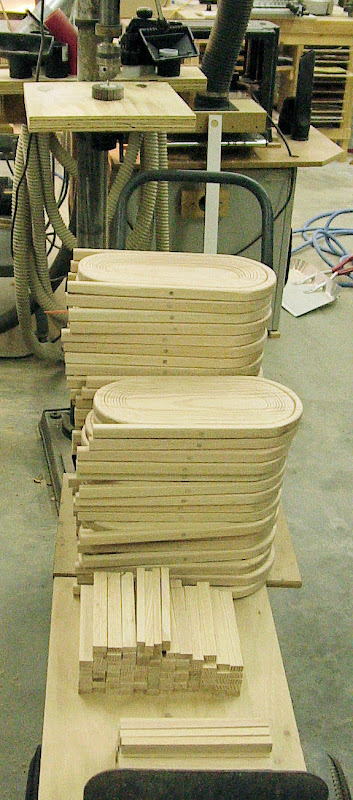
Next, the bases have to be glued and nailed on. And that's where I am at the moment. I've got to finish this pile today:

From Stonekettle Station

That's about 40 pieces there on the project cart. And once the bases are done, I'll do a quick powered finish sanding of the whole run, and then coat them all in Danish oil.

So, you know, if you don't see me for the rest of the day, I'm in the shop hating the Amish.

Tuesday, September 23, 2008

And Again, Attention Idiot Parents

Here's the thing, parents, it's the 21st Century.

Got that?

It's not the Dark Ages, we understand what causes communicable disease. It's not the miasma of bad air, or phases of the moon, or God's wrath, or demons, or an imbalance of the body's humors.

It's germs: viruses and bacteria and sometimes prions.

Yes, in some emerging diseases, and even some that have been around as long as we have, not all of the mechanisms and propagation vectors are understood. But for the most part we have a fairly thorough understanding of what causes infectious disease.

And while we may not know everything about disease, and we may not be able to prevent or cure everything, yet, there are some things we pretty definitely do know about disease prevention:

Disease is not prevented by praying. During the Black Death - i.e. the Bubonic plague pandemic that ravaged Europe and Asia for most of the 14th Century - 75 million people died or nearly 50% of Europe's total population and, trust me here, those pious bastards were praying their infected asses off. They sang hymns and flagellated themselves until they bled and prayed for deliverance and prostrated themselves before God almighty - and still they died, in great festering, pus-filled masses. Religion, faith, prayer, and all the cathedral building in the world did exactly jack shit to save those people. All the belief in the world will not prevent the spread of infectious disease, especially when you're shitting in your water supply or kissing the bishop's ring along with every other sneezing gomer in the area. Period. What's that? Oh, I'm wrong am I? Prayer does work you say? Okey Dokey, let's take the Pope and drop him into the middle of Panama and see if his prayers keep him from getting malaria, or sleeping sickness in the African Congo, or yellow fever, or anthrax, or etc. In fact, during the Black Death, one of the hardest hit populations was the clergy due to their proximity to large numbers of the infected. Their supposed piety didn't help them at all, and in point of fact their very beliefs were in large part a contributing factor in their infection. Again, your religion will not, in any way, prevent or reduce your chances of being infected if you come in contact with a communicable disease vector. Period.

Disease is not prevented by 'alternative' medicine. All the organically farmed homeopathic herbal supplements in the world won't keep you from getting diphtheria, amoebic dysentery, measles, mumps, or the common cold. I don't care if you 'treat the whole body' by eating a bale of raw saw grass and purging the 'toxins' from your system by drinking a gallon of pureed wheat germ every day under a bank of broad spectrum sun lamps. If somebody with whooping cough sneezes in your face, there's a pretty high probability that sooner rather than later you're going to be yakking your fluid filled lungs out on floor.

Disease is not prevented by ancient remedies, 'natural medicine', harmonic resonance, roots, bark, crystals, star alignment, or juju magic. Ancient Native Americans did not have some secret cure for disease now lost to modern civilization. Their lives were brutal, short, and not in some kind of 'harmony' with nature - it only appears that way due to the insulation of time and the biased nostalgia of a certain type of predisposed perception to see pre-industrial Native Americans, Aboriginals, and and other native peoples as some kind of magical people who lived in peace and harmony at one with the universe. It's not true and never was. When Europeans first came to the New World, they brought with them all of the diseases of their world. Those diseases decimated the native populations. All the Ghost Dancing, shamanic magic, and native cures were useless. When British General Jeffrey Amherst, later Lord Amherst, led the Redcoats against the Ottawa and their native allies in what is now New York and Pennsylvania, he had his men distribute smallpox infected blankets to the Indians. All the juju magic and ancient remedies did nothing, nothing, not one damned thing, to stem the resulting decimation among the tribes of the Great Lakes. If you believe that ancient tribal medicine will keep you from getting smallpox, well, then you are an idiot, and really, good luck with that.

The Government, the Pharmaceutical Companies, and the Insurance agencies are not in some big secret global conspiracy to make you sick and keep you that way. Scientists are not a bunch of evil bastards bent on turning your kids into autistic zombies or giving gay people aids so that the pharmaceutical companies can make billions off of your suffering. The vast majority of the folks at the CDC and government labs, commercial research organizations, and the like have dedicated their lives to making the world a better and safer place - and in large part they have done just that. From about 1910 to the mid 1950's, polio epidemics ravaged America, Europe, New Zealand, and Asia. Millions were infected and hundreds of thousands were killed or crippled - in 1952, there were nearly 60,000 cases of polio in the United States alone. Government and private industry poured billions of dollars into research and eventually Scientists like Salk and Sabin found a vaccine. That vaccine has saved millions and reduced the number of polio cases to less than a thousand world wide annually. If that vaccine had not been found, and widely implemented, polio would be a full blown pandemic in our modern world of high population densities and easy global transportation. If the government and pharmaceutical companies were really truly bent on placing profit over public health they would have been far better served to withhold the cure and keep making iron lungs - a complex medical machine costing hundreds of thousands of dollars - vice the paltry couple of bucks they make off each polio shot. Something I want to point out here: Just because pharmaceutical companies make a profit, does not automatically make them evil bastards or engaged in conspiracy to steal your money by making you sick. What? What's that you say? Pharmaceutical companies should just give that shit away? Out of some kind of humanitarian ideal, right? Bah. Blow it out your ass. Pharmaceutical companies are just like any other company, altruism is all fine and well, but unless you've got a big fat endowment or, you know, actually make a profit, you won't be in business very long. Here's the thing that kills me about that particular mind set: homeopaths who sell bottles of powered roots and blended saw grass smoothies make a profit, the churches make a profit (100% tax fee here in the US, and don't try to tell me that the major churches, TV evangelists, and the tent preachers aren't making a profit), the folks who sell crystals and snake oil miracle cures on the home shopping network and the Internet make a profit - so why aren't they evil bastards too? Seriously, if everybody was healthy all of these people would be out of business - how come they're not part of the global conspiracy instead being the ones leading the charge? In fact, the people who stand to gain the most from a global conspiracy are conspiracy theorist themselves. Without a pharmaceutical company conspiracy, all of these people would be nobodies. Now, do pharmaceutical companies charge too damned much for their products? Well, that depends entirely on your view point doesn't it? Let's look at an example: the cocktail of protease inhibitors that are used to treat AIDS costs literally thousands of dollars per month, and they cost the pharmaceutical companies billions to develop - a condom costs about fifty cents. A rather large number of folks with AIDS got the disease through risky behavior, and are demanding that somebody, anybody, but especially the pharmaceutical companies pay for the cure. Another example, a pack of cigarettes costs about $6 here in the Alaska. A pack a day smoker spends about $200 a month on smokes, give or take, and over two thousand a year. What's that? Sixty, seventy thousand over thirty years? The drugs, Spiriva (tiotropium) used to treat COPD, a form of emphysema, can cost well over a hundred dollars a month, or about the same as the habit that gave the victim the disease in the first place. So, let's dispense with the bullshit that pharmaceutical companies are villains, shall we? Should there be regulation? Sure. Should there be some kind of assistance for folks who need medicine and can't afford it? Sure. And etc. Now, I don't want this post to wander off into some kind of discussion of socialized medicine or national insurance or health coverage. But the bottom line here is that there are enough diseases and emerging diseases without the either the government or the pharmaceutical industry colluding to make you sick and keep you that way - in fact, they make an even larger profit by doing just the opposite.

And last: The Internet is biased. The sea of information is vast and limitless. Some of it is accurate, some if it is widely off the mark, some of it manufactured whole cloth by the deluded or the insane or the stupid, some of it is outdated, and some of it is generated spontaneously by hysteria, fear, and ignorance. If you believe something, and you search for it - you'll find plenty of reasonable sounding information to support your belief. The results of the following searches produce completely different results: Vaccines cause autism and autism. Both are biased for a variety of reasons. The first phrase is indicative of a bias in search criteria, i.e. the searcher already suspects that vaccines cause autism and is looking for supporting information. Additionally, all modern search engines are biased, deliberately so, with search results weighted by a large number of factors. In many cases this deliberate bias is an advantage to the search when looking for basic information or services. However, when it comes to the foundation of belief systems, this bias can be a form of self reinforcing information warfare and unintended manipulation of perception.

Now to the point of this post, which is this: Get your Goddamned kids immunized or keep them home.

No. Shut the hell up. Shut up and go out right now and get your kid immunized. Drop the hysterical, pseudo scientific, mumbo jumbo, juju, herbal homeopathic, religious bullshit. Get your kid immunized or keep him the hell away from my child. Keep him or her out of the public school system. You want to home school or send your kid to one of those religious schools where they pray away disease, fine by me, but keep your goddamned kid out of the public schools.

Should you use reasonable caution? Yes, absolutely. Should you get your information regarding vaccines from your doctor instead of some on-line forum full of crazed conspiracy nuts who believe exactly as you do? Hmmm, yeah, might be a good idea. Should you look at family history regarding sensitivity to certain types of vaccines? Yes. Should you ask about side effects and be observant for a reaction in your children? Yes, of course.

But for the love God, Parents, there is no damned reason whatsoever for your kid to show up at my son's school with a full blown case of fucking whooping cough.

You might think you're protecting your child, but not getting him or her immunized is no different than all of those people who ripped the flesh from their own backs in order to become more Christ-like during the Black Death. Their actions came from ignorance and a lack of real prevention methods - your actions come from ignorance alone. You are not protecting your child, you're putting him or her at risk. That's bad enough, but you're also risking my son's health - and that is completely unacceptable.

Monday, September 22, 2008

Winter in the Pass

Winter's coming folks.

Faster than I like too.

We wanted to get one last hike in before the snow falls, but unfortunately that just wasn't the cards. I've been in a lot of pain this last week and just could not see myself putting on the pack and the shoulder holster and slogging though the mud. Everything hurts, but especially my neck and shoulder. It's been inflamed for a week now, but it's getting better. Nothing particularly unusual for me, the damp and cold always cause me problems. Regardless, the scenery is spectacular this time of year, and we wanted to get out and enjoy it while we can.

So, this Saturday we settled for driving up to one of our favorite places, Hatcher's Pass, to let the dog and the boy play in the snow. Besides, my truck has heated seats and that's almost has good as a heating pad on my back. The road to the pass is still open, but it won't be for much longer, the snow is already down to the three thousand foot mark.

This is a panorama shot looking down from the pass at Government Peak. As always, you can click on the picture and get a higher resolution shot from my Picasa album.


From Stonekettle Station

I put the truck into 4-wheel drive and we bounced through the mud and slush up to the actual pass itself and looked down on Summit Lake. The lake is at about the 4000 foot elevation mark and it was about 35F out. The lake is pretty deep and hasn't cooled down enough yet to freeze over, but it won't be much longer before the ice starts to form.

From Stonekettle Station

On the way back down from the summit, I stopped to take a few pictures and my son climbed up the hill to pick a few late season wild blueberries.

From Stonekettle Station
The hills here are covered in wild low-bush blueberries and a lot of folks come up here with hand sweeps to pick them by the bucket full. Unfortunately this summer we've had torrential rain and very little sunshine. The berries need a lot of sunlight to develop a high sugar content, and this year is just didn't happen, so they're bitter and not that good tasting - or said my wife and son, me personally I don't care much for blueberries and didn't bother trying them.

While my son was roaming the hillside the clouds parted and a shaft of sunlight illuminated the valley floor and I was able to get a nice series of shots:

From Stonekettle Station

Yesterday I was feeling a bit better and was able to wear the shoulder holster for a while. So we took a nice hike through the yellowing foliage along some of our neighborhood trails. Didn't see any bears or moose, though they're about. I also didn't get any pictures, so you'll just have to imagine the deep Alaskan woods in your mind.

Today the pain is better, though I can't turn my head very far. I've got a pile of work in the shop that needs to be done and a couple of errands to run. More later.

So, what did you do with your weekend? I mean besides Jaunt off to Florida and such.

Friday, September 19, 2008

Big Damn Science

As I'm sure most of you know, we're big on the cutting edge sciences here at Stonekettle Station.

Especially Plasma Physics.

With all the hoopla surrounding the Large Hadron Collider , the Stonekettle Station Research Division wanted to do our part for the advancement of entertainment science - you know before those crazy Swiss bastards cross the streams and the world ends in a 12" ball of compressed degenerate matter orbiting near light-speed somewhere north of the chocolaty new singularity that used to be Switzerland.

Now, despite the enormous capability of the LHC and it's Bush-like potential for world ending catastrophic failure, it can't do everything. Like Rush Limbaugh's ego, it's just too damned big. It's a little known fact that originally, the LHC was created by scientists out of spare stereo parts in order to warm a cup of Top Ramen noodles to the temperature of the Solar corona, but those little Styrofoam cups kept exploding with great big Bangs - eliciting shouts of "Oh God!" and fits of giggles from the hungover post-grads (In fact, LHC originally was an acronym for "Look! Holy Crap!" Fact, you can look it up.)

And that's how all great scientific discoveries are made, by accident - usually food related.

CERN purchased a smaller microwave oven for the research staff and turned the LHC towards the hunt for the so called "Oh God!" particle.

Unfortunately, like the rumored Alaska State Quarter, the God particle as never actually been seen by man and in fact may not even exist. The hunt for it is all consuming and leaves CERN scientists little time for pursuing other less famous and even more elusive particles such as the "One Missing Sock" particle, the "Iraqi WMD" particle, or the highly theoretical "George W. Bush's Brain" particle.

And that's where we at Stonekettle Station come in.

About eight months ago we set out to acquire our very own high definition plasma-based electron supercollider. And as every particle physicist can tell you, the best place to find such cutting edge, advanced entertainment research technology is COSTCO. There was some dispute between the scientists and the accounting department regarding the best base technology, plasma projection or LCD - the research assistant didn't care, just as long as it was "Playstation compatible with minimal lag time and big honking speakers." Eventually we settled on a Mitsubishi Plasma DLP wide-screen in the 40gigawatt range with like a bizillion different kinds of input and an gargantuan, multifunction, super technical remote control (seriously, the manual for the remote was the size of the LA Yellowpages and came in four incomprehensible languages, including Engrish, so you know it's good science).

After some initial configuration issues, we brought the monster on-line seventeen months ago and have been smashing electrons into a non-reflective charged 67" wide screen and conducting advanced research across a broad spectrum of digital cable and HD DVD's ever since.

So, for the last year, things have been good - no sign of that GWB Brain particle though and we believe that it may not be a particle at all, but rather a "collapsed wave function." We did however find two missing socks and a catnip mouse when we moved the older tube-based electronic collider to make room for the new machine.

Unfortunately, Monday, we accidentally generated a black hole, a big rectangular one.

There was much screaming, crying, and general waving of the arms in an aimless Nancy Pelosi like fashion - we had intended to to conduct a thorough review of last season's Heroes in preparation for the upcoming new season's research and the failure of our equipment threw the entire lab schedule into disarray. Besides, Monday night Alton Brown was doing a review of the physics behind beer and we missed it. This vexed us mightily.

Eventually after much rigorous testing (which consisted mostly of my wife looking for the manual, and me whacking the side of the device and cursing), we determined that the main mercury-sodium plasma-electron projector (i.e. the "Lamp") had failed or what we in the applied technical sciences refer to as "shit the bed."

After much consternation upon discovering that a replacement lamp cost several million dollars (OK, $200 plus S&H, but still), the accounting department remembered that we had gotten COSTCO's automatic 2-year warranty extension. We contacted COSTCO "Concierge Service" (which I guess, is the fancy way of saying "service department," but then again "concierge" lends an international flavor to the process and that can't be bad). They talked us through some highly rigorous diagnostics, i.e. unplug the TV, now plug it back in, and try to turn it on. The diagnostics confirmed the lamp failure.

COSTCO then promised us a replacement unit via 2-day UPS Air, which arrived right on schedule yesterday.

The replacement unit contained directions and many, many dire warnings about mercury poisoning and high voltage electricity which I mostly just ignored. I unscrewed the access panel on the back of the unit -which contained even more dire and horrific warnings about mercury, high voltage, user serviceable parts, bright lights, gremlins, particle beams, black holes, and animal dander - popped out the old module and inserted the new one.

No joy.

Seems you actually have to put the cover back on before powering up the particle accelerator, there's a safety lock out. Don't want an undergrad accidently leaving a LEGOS Star Wars storm trooper in there, or you know, one of the research animals). Not wanting to endanger the genetic future of everybody in a hundred mile radius, I reattached the cover and fired that sucker up.

The lights dimmed. Two nuclear cores at the Palmer Atomic Power Plant and Bakery came online under emergency startup, oil prices rose, and the resulting photonic barrage of excited electrons blinded the Hubble Space Telescope and disrupted weather patterns from here to Nome. Over head, the aurora flamed and roared.

It was, as they say, a thing of beauty.

So, after a four day hiatus, Stonekettle Station high definition plasma research is back in business, riding the razor sharp edge of particle physics and bringing us all one step closer to the heat death of the universe and the third season of Heroes in digital HiDef.

You can thank me later, if we're not all eaten by black holes first.

______________________________________

All of which is a fancy way of saying that since I didn't have anything else to blog about today, I talked about my stupid TV set.

One thing, COSTCO Concierge Service was just plain outstanding. Prompt, courteous, knowledgeable, and aggressive about living up to their obligation. I've rarely been so impressed by customer service. After we contacted them initially, they assigned a dedicated technician to our problem, gave us a direct access phone number, ordered the part, and called back the next day to confirm that the part was on its way via the most expedited method possible and to give me a tracking number. They asked if I was comfortable performing the replacement swap-out myself or if I would prefer a service technician to come to my house and take care of it. Once I confirmed that I felt fully qualified to open the set and change what was essentially a big damn light-bulb, they provided me with a complete set of directions and a toll free number to call if I needed real-time assistance during the process. They also provided return postage for the failed unit. And they just called back here about ten minutes ago to confirm that I had received the part and that everything was working properly.

And that, folks, is how you do customer service. Outstanding COSTCO, and thanks, you've got yourself a dedicated customer.

Thursday, September 18, 2008

Offline for the morning

Folks, I'm strapped this morning.

I've got a couple of things inbound that I have to deal with. So, no posts this morning.

But I'll have something good later. In the meantime go read Sarah Palin's email or something, I'll be back in a while.

Wednesday, September 17, 2008

Foot, Mouth - Never a Good Combination

Interviewer: "Do you think Sarah Palin has the experience to run a major company, like Hewlett-Packard?"

Carly Fiorina: "No, I don't. But you know what? That's not what she's running for."

Heh, heh.

That response by Fiorina, herself the former CEO of HP and an initial contender for McCain's running mate, would have been just another glib off-the-cuff remark - if she wasn't one of McCain's top advisors and spokespeople.

She made that gaff on St. Louis radio station KTRS yesterday - and, fairly obviously, realized that she'd put her foot in her mouth. So, during another interview, an hour later with NBC's Andrea Mitchell, she tried to explain the above remark in more detail by saying, "Well, I don't think John McCain could run a major corporation. I don't think Barack Obama could run a major corporation. I don't think Joe Biden could. But that's not the same as being the president or vice president of the United States."

Predictably Obama's campaign wonks went bugshit crazy over that remark, and by a number of accounts McCain himself was furious with Fiorina.

But wait, it gets better - McCain's top economic advisor, Douglas Holtz-Eakin, in an effort to address questions regarding McCain's economic and technical knowledge, basically claimed in front of the world yesterday that John McCain invented the Blackberry.

Bawahahahahahaha!

Oh hell yes, this campaign is nothing if not entertaining. Who'd have thought that that John "I was a POW Goddamnit!" McCain and Al "bunnies, and trees and rainbows, oh my" Gore would have something in common? Who says there isn't hope for a bipartisan government? I tell you, when the pinnacle of conservative economic business technology connects seamlessly over the liberal Internet, when John and Al have something in common, well it just gives me a warm and fuzzy feeling all over. And frankly, the thought of liberals looking at their Blackberries with sudden horror, or conservatives suddenly realizing that their communication device is connecting over the Daily-Kos powered Internet give me more than a touch of glee.

Now, obviously (at least it's obvious to me) neither Fiorina or Holtz-Eakin meant their words the way they were taken - but taking sound bites out of context is an old and approved campaign tactic and people like Fiorina and Holtz-Eakin should have known better than to make impromptu remarks.

Fiorina is correct, mostly - the president of the United States is not the same as the CEO of a major company. Alas, maybe our economy would be better if it were. But I do understand where she was coming from with that statement (truthfully, HP's board of directors didn't think Fiorina was able to run HP either, so they ditched her, which you know, kind of makes her an expert, just saying). But seriously, what the hell was she thinking? Talk about a case of uncontrolled verbal diarrhea - help me! I can't stop!

And Holtz-Eakin wasn't actually saying that John McCain personally invented the tool Palin uses like a crack addict (seriously, have you seen that woman's thumbs? I'll bet she could bench press a lipstick covered pitbull with those mitts), any more than Al Gore actually claimed that he personally invented the Internet. Holtz-Eakin was trying to make the point that McCain chaired the Senate Commerce Committee and helped to create a climate of technology based economic growth - i.e. McCain is both technologically and economically savvy. That's what he meant but that's not what he said, and he's been around long enough to know better.

When you're a spokesman, you stick to the script. If you deviate from the approved talking points, especially in campaign politics, you are absolutely guaranteed to end up ass deep in starving alligators.

And McCain himself isn't immune - he and Palin have both engaged in some serious truth stretching if not outright falsehoods. But, yesterday McCain said, "I was Chairman of the Commerce Committee that oversees every part of our economy." Well, no, that's just plain wrong. The Senate Commerce Committee doesn't oversee a couple of critical portions of our economic foundation, in fact by law the committee is excluded from addressing credit, financial services, and housing finance. Those things are the purview of the Senate Banking Committee - and they are the very things that are right now crashing and burning. McCain might want to think twice about claiming to be part of the process that led directly to the current economic meltdown, or to claim knowledge and experience in areas where he clearly has none.

Both campaigns are scrambling - Obama to take advantage of the GOP's hoof and mouth outbreak, and McCain's people are jumping to damage control stations.

Hilarity ensues.

But in between chuckles I'm feeling a ominous foreboding.

If these are the types of advisors John McCain has running his campaign, who does he plan to listen to once he actually is in charge of the economy? And if Obama is the type of person to revel in sound bites taken out of context, clearly out of context, deliberately out of context, what kind of leader and role model will he be?

And suddenly things aren't so funny, are they?